


Endoscopic Spine Surgery
Minimally invasive technique for relieving back pain and accelerating recovery
Endoscopic spine surgery is an ultra-minimally invasive technique that uses a specially designed instrument, the endoscope. This allows surgeons to view and reach small areas of the spine without the need for the large incision required for traditional spine surgery.
If you have chronic low back pain, failed back surgery syndrome or have experienced degenerative changes in the lumbar spine, this option can help you alleviate pain and regain your function again.
What to Expect with Endoscopic Spine Surgery
The goal of surgery is to relieve pressure on spinal nerves and improve symptoms such as leg pain, arm pain, numbness, weakness or difficulty walking. Nerve-related pain may improve early, but numbness, weakness and overall function can recover more gradually. Surgery may not eliminate every symptom or prevent all future spine problems.
There are different approaches to endoscopic spine surgery. Your treatment plan will depend on your condition and expected outcomes.
Endoscopic Spine Treatment Options:
- Medial Branch Transection involves cutting or disrupting the sensory nerves that run along the spine. Your surgeon will use an ultra-minimally invasive endoscopic approach to reach and view the medial branch nerve, then split it. This procedure can help those suffering from low back pain due to conditions like facet joint arthritis, chronic back stiffness or muscle spasms.
- The Interlaminar Approach treats herniated discs and spinal stenosis. It is most often used to treat herniated discs in the lower back, generally at the L4-L5 or L5-S1, which are levels of the lower back (lumbar spine) where spinal discs are located between certain vertebrae. Surgeons will use ultra-minimally invasive instruments, including a spine endoscope and high-resolution camera, to reach and remove the herniated portion of the disc.
- The Transforaminal Approach is most commonly used to treat herniated discs in the lower back, generally at the L3-L4 or L4-L5 levels of the lumbar spine. Your surgeon will make a small incision along the “ridge” of the back, above the herniated disc. The ultra-minimally invasive endoscope allows surgeons to get a direct view of the herniation and remove it.
Prior to surgery you may need blood work, imaging, medical clearance or an anesthesia evaluation. Discuss fasting instructions as well as transportation and support with your medical team. Nicotine can affect healing and increase the risk of complications. If you smoke, vape or use nicotine products, discuss a plan to stop before surgery.
Preparing for Endoscopic Spine Surgery
Prior to surgery you may need blood work, imaging, medical clearance or an anesthesia evaluation. Discuss fasting instructions as well as transportation and support with your medical team. Nicotine can affect healing and increase the risk of complications. If you smoke, vape or use nicotine products, discuss a plan to stop before surgery.
Recovery
Recovery varies based on the condition treated, the area of the spine involved, the specific procedure and your overall health. Many endoscopic spine procedures are performed as outpatient surgery, although some patients may need an overnight stay.
Questions to Ask Your Provider
- What condition is causing my symptom, and what is the goal of surgery?
- What type of endoscopic spine procedure are you recommending?
- Why is this approach appropriate for me instead of nonsurgical care or another type of surgery?
- Which symptoms are most likely to improve and which may take longer to recover?
- What are the important risks?
- Will I have general anesthesia, sedation, or another type of anesthesia?
- Is this expected to be outpatient surgery, or might I stay overnight?
- Which medicines should I take, stop, or adjust before surgery?
- What activity and lifting restrictions will I have after surgery?
- When can I shower, drive, return to work, exercise and resume sexual activity?
- Will I need physical therapy?
- Who should I contact after surgery if I have questions or concerning symptoms?
Frequently Asked Questions
Will I go home on the same day?
Many patients go home the same day, but this is not guaranteed. Your discharge plan depends on the procedure, anesthesia recovery, pain control, ability to walk safely and medical needs.
Will I be awake during surgery?
This depends on the procedure and anesthesia plan. Some procedures are performed with general anesthesia, while others may use sedation with local anesthesia. Check with your anesthesia team to review the safest option for you.
Is endoscopic surgery safer than traditional open surgery?
Endoscopic surgery may reduce tissue disruption and incision size for selected conditions. However, all spine surgery has potential risks and a smaller incision does not mean there is no risk. The best approach is the one that most safely and effectively addresses your condition.
Will I have a scar?
Yes, but the incision is usually small. Scar appearance varies from person to person and often improves over time.
Will surgery completely relieve my pain?
Surgery is intended to treat the specific structural problem identified during your evaluation. Many patients experience meaningful improvement, especially in nerve-related arm or leg pain. However, results vary and some symptoms may improve slowly or may not completely resolve.
Will I need physical therapy?
Not every patient needs formal physical therapy. Your provider may recommend physical therapy, a walking program, or home exercises based on your diagnosis, procedure and recovery.
When can I return to work, exercise or sports?
The timing is different for every patient. Patients with desk-based jobs may often return within 1-2 weeks, while patients with physical jobs may need 4-6 weeks or longer. Return to higher-impact exercise and sports is gradual and is often measured in months rather than weeks. Ask your provider for guidance based on your procedure and recovery.
Sep 24
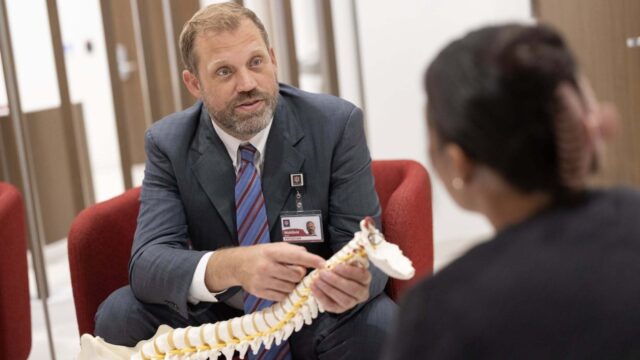
IU Health Bloomington neurosurgeon Bryan Wohlfeld, MD, stopped a patient's pain through a minimally invasive endoscopic spine procedure.
Patient Stories for Endoscopic Spine Surgery
Sep 24
IU Health Bloomington neurosurgeon Bryan Wohlfeld, MD, stopped a patient's pain through a minimally invasive endoscopic spine procedure.