


Milestone builds on years of clinical research and IU Health’s investment in theranostics and precision imaging
INDIANAPOLIS – Indiana University Health is the first health system in the nation to administer a newly FDA-approved imaging drug designed to help physicians evaluate suspected recurrent brain cancer, marking an important step forward in precision oncology and reinforcing IU Health's commitment to advancing theranostic care for patients.
The first patient at IU Health received Pixclara® (floretyrosine F 18 or 18F-FET), an imaging drug developed by Telix Pharmaceuticals and now approved for use in adults and children with possible recurrence of glioma, a type of brain tumor diagnosed in thousands of Americans each year.
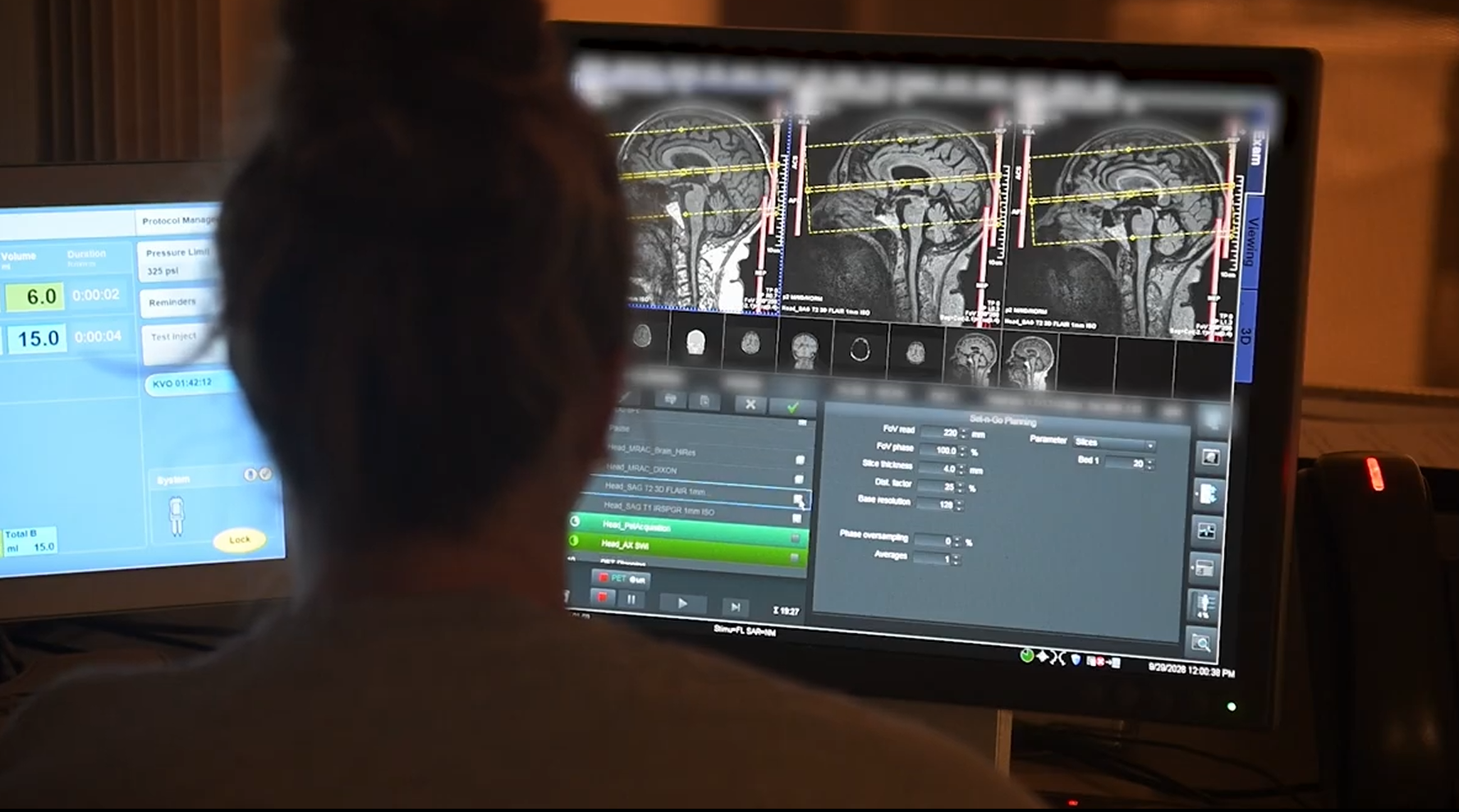
One of the challenges in monitoring treated brain tumors is determining whether changes seen on traditional imaging represent cancer recurrence or effects from previous treatment. This advanced molecular imaging provides physicians with additional information that can help distinguish between the two and guide decisions about a patient's next course of care.
“Our physicians, researchers, technologists and clinical teams have spent years advancing this work. Today, patients are benefiting from that expertise,” said Dennis Murphy, president and CEO of IU Health. “As Indiana’s largest health system and an academic health center, IU Health has a unique opportunity to move promising discoveries from research into real-world patient care.”
IU Health and Indiana University School of Medicine bring significant experience with this type of advanced imaging. Since 2020, clinical teams have performed more than 700 advanced brain tumor imaging scans through clinical research, contributing to the evidence and expertise that helped move this technology from investigation into clinical care.
“For patients with brain tumors, having clearer information can make a meaningful difference in determining what comes next,” said Dr. Na Tosha N. Gatson, director of the Center for Neuro-Oncology as part of the IU Health-IU School of Medicine Neuroscience and Cancer Institutes. “Years of research have helped bring us to a point where we can now offer physicians another advanced brain tumor imaging tool to better interpret findings and help guide decisions about a patient’s care. The ability to detect tumor progression earlier allows us to preserve patient well-being and initiate more effective therapies.”
This advancement reflects a broader commitment by IU Health and IU School of Medicine to accelerate clinical research and bring promising discoveries to patients. That commitment includes IU Health’s recently announced Theranostics Center of Excellence, which brings together expertise in advanced imaging, targeted therapies, research and patient-centered care, as well as the Tobias-Lechleiter Institute for Clinical Innovation, established in 2025 to expand access to clinical research and advance new approaches to disease detection and treatment.
“This is exactly the type of innovation our Theranostics Center of Excellence was created to support,” said Dr. Jason Allen, chair of the Department of Radiology and Imaging Sciences at IU School of Medicine and leader of the IU Health Theranostics Center of Excellence. “By bringing together clinical expertise, research and advanced imaging capabilities, we can accelerate patient access to leading-edge care while continuing to contribute to the scientific discoveries shaping the future of medicine.”
As IU Health continues to expand theranostic capabilities throughout the state, leaders say the ability to bring newly approved technologies to patients quickly underscores the value of Indiana’s unique partnership between academic medicine, clinical research and community care.
“This advancement builds on the longstanding collaboration across IU Health and IU School of Medicine,” said Dr. Michele Saysana, president of IU Health Methodist and University Hospitals and Metro Region at IU Health. “We are grateful to the physicians, researchers, imaging specialists, pharmacists, technologists and clinical teams who helped advance this work, as well as the patients who participated in research and made this progress possible.”
“This is an incredible milestone that will not only save lives, but also further establish Fishers, and Central Indiana, as a hub for life science and healthcare innovation,” said Fishers Mayor Scott Fadness. “As the home of Telix Pharmaceuticals’ U.S. headquarters, we work every day to create a community where industry, researchers and healthcare providers can come together to accelerate breakthrough discoveries and bring innovative new options to patients. Today’s announcement is a great example of what can happen when a community goes all-in on life sciences and we're grateful to play a small part in this exciting new advancement in oncology treatment.”
Patients seeking more information about advanced imaging and treatment options for cancer should speak with their care team or click here.
About IU Health
Indiana University Health is Indiana’s most comprehensive healthcare system. An academic health center, IU Health provides leading-edge medicine and treatments.
News Hub
Stay up to do date with the latest patient stories, wellness trends and news updates from around IU Health.