


August 19, 2025
Therapist uses art as creative expression with neurology patients
IU Health Simon Cancer Center
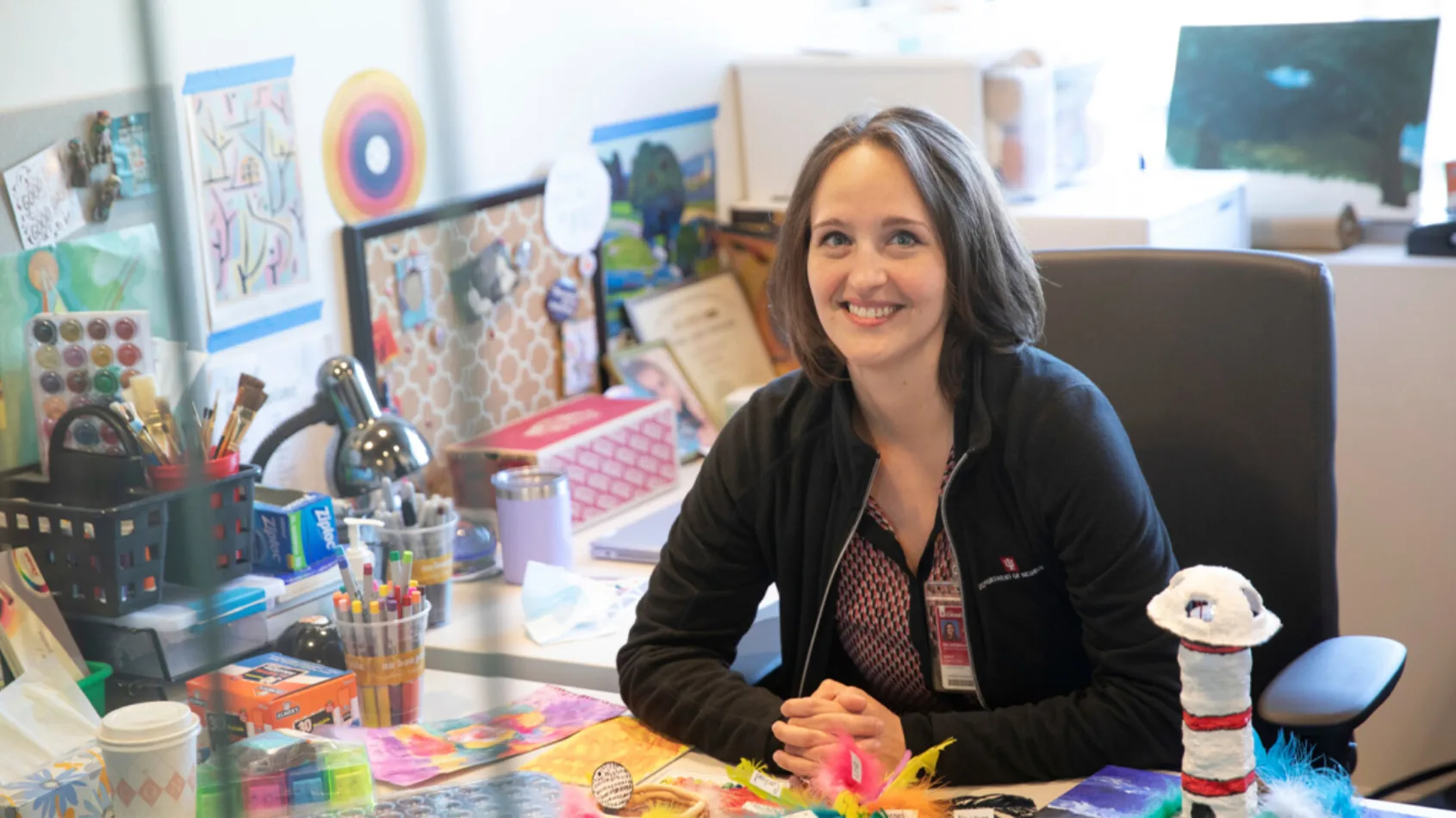
As the IU Health Cancer Resource Center prepares for its 8th Annual Art Show one therapist talks about the importance of art therapy.
By TJ Banes, IU Health Senior Journalist, tfender1@iuhealth.org
Patients, caregivers and staff members - all levels of artists – are encouraged to submit their entries for this year’s CompleteLife Art Show. The theme: “Flaws: A Beautiful Mess,” will open September 11. The exhibit continues through September 26 in the lobby of Simon Cancer Center. Entries may be submitted to the Cancer Resource Center. Deadline for entries is August 29 at 3 p.m. For more information email: CompleteLife@iuhealth.org.
Art is one of several therapies attending to the holistic health of patients. Other therapies include yoga, music, and massage. Ashley Hildebrandt, one of three art therapists talks about her role and the importance of art therapy in patient health.
Hildebrandt, a board-certified art therapist, started her position in 2018 under IU School of Medicine. She then transitioned to IU Health (under Neuroscience Administration) in 2023, and then to CompleteLife in August 2024.
Before joining IU Health:
I worked for several years in inpatient psychiatric facilities and intensive outpatient programs, facilitating art therapy groups with children, adolescents, adults, and older adults.
How did you become interested in art therapy?
I didn't know that art therapy existed until I was 17. I started painting in my free time while struggling with anxiety and depression and immediately noticed how much better I felt afterward. My parents could see the difference. I'll never forget the day my dad mentioned, "there's this thing called art therapy." From there, I researched as much as I could about the profession and even located one of the very few art therapists working in Indiana at the time. After that one phone call, I knew I was meant to be an art therapist and haven't looked back.
Do you have a specialty - medium that you work in personally?
Cross-stitch is my favorite thing to do at the moment. I enjoy designing personalized patterns to stitch for family and friends as gifts, usually with the intention of making them laugh.
What was the spark that made you want to pursue art seriously?
I grew up in Southern Indiana in a family of art appreciators. I felt bored by trips to museums until I saw an exhibition of Matisse's cut-outs nearly 30 years ago. It opened my eyes to how joyful and fun art can actually be. I was hooked. One of my favorite possessions is a Matisse poster I got from the exhibition gift shop. I later attended Indiana University, where I studied Studio Art, Psychology, and Art History. I earned my master's in art therapy from Drexel University in Philadelphia, PA in 2011.
What exactly is your role with neuroscience? Describe what you do and how you interact with patients.
The art therapy program at IU Health Neuroscience Center started in 2016 under the leadership of art therapist Juliet King and Dr. Robert Pascuzzi (then-chair of the department of neurology), with the purpose of improving quality of life for adult neurology patients and their caregivers. As far as we're aware, we're the first art therapy program in the world to operate within an outpatient neurology clinic. Neurological diseases are often considered to be invisible illnesses, contributing to a sense of isolation. We use creative arts interventions to help individuals cope with anxiety, depression, or even the stress of living with neurological symptoms of an unknown cause. Treatment goals are personalized for everyone we serve but often include the development of outlets for creative self-expression, improving communication skills, supporting self-confidence through the mastery of new skills, gaining social support, as well as experiencing moments of peace and joy through creativity. (An example is a mural, “Forget-Me-Nots” created by a group of neurology patients and care partners honoring those diagnosed with dementia and Alzheimer’s).
Personally:
Hildebrandt is married to a professional illustrator. They have three children. She enjoys spending time with family, listening to live music and visiting museums. For any questions, please contact ahildebrand1@iuhealth.org
