


December 04, 2025
Founder of ‘Straight No Chaser’ turned to IUH for treatment of rare diagnosis
IU Health Simon Cancer Center
It was something unexplainable. It was hard to pin down, but when the diagnosis was discovered, this musician turned to IU Health Simon Cancer Center for treatment.
By TJ Banes, IU Health Senior Journalist, tfender1@iuhealth.org
He lost sensation in his feet. His mobility was impaired. Something was not right with David Roberts’ health. At 48, he faced months of tests, a series of doctor visits, and questions.
An Indiana native, Roberts graduated from North Central High School where he was a member of the award-winning show choir, “Counterpoints.” He went on to obtain his degree in accounting from Indiana University Bloomington. In 1996, Roberts co-founded the a cappella musical group, “Straight No Chaser.” Over the years, members changed, and the group began touring. A reunion of the founding members led to an album with Atlantic Records. Roberts, who performed as a baritone, continues to serve as the group’s manager.
He married his wife, Sara, 13 years ago. They are the parents to two boys ages 9 and 11, who also enjoy music.
It was May when the couple faced David Roberts’ health issues.
“There was no real diagnosis. They thought it was one thing and then possibly something else. It was looking at what meets the criteria, for the diagnosis,” said Roberts.
The first doctor to put a label on Roberts’ condition was Dr. Mark Dayton, who worked at IU Health Bloomington. That diagnosis was a rare blood disorder, “POEMS syndrome.” Dayton died on Aug. 11, 2025, when he was struck by a car while riding his bicycle. He was 70 and had dedicated his career to medicine.
With a diagnosis, and little known about treatment, Roberts and his wife turned to IU Health Simon Cancer Center. POEMS syndrome can cause damages to the nerves – numbness, tingling, and weakness in the legs and hands. Patients may also have an enlarged spleen, liver or lymph nodes, an underactive thyroid, changes in skin color, and a thickness or hardness of bones. Some researchers believe POEMS is linked to people with increased numbers of plasma cells from a protein that results in the various symptoms. Practitioners believe POEMS is most often detected in males over the age of 50.
At IU Health, Roberts is in the care of Dr. Attaya Suvannasankha, who specializes in hematology and conducts research on POEMS.
“Mr. Roberts came to me after a long and challenging search for answers. He had seen several specialists for a wide range of symptoms, but nothing quite fit until his doctors suspected a plasma cell disorder and referred him to our program. When we met, the pattern pointed strongly to POEMS syndrome, which we were able to confirm and treat,” said Dr. Suvannasankha.
“As a hematologist who specializes in plasma cell disorders like myeloma, I’ve encountered a few rare conditions such as POEMS. It’s a difficult disease to recognize because it touches so many parts of the body—nerves, hormones, skin, and more. It really takes a team of experts working together to put the pieces together. Treatment for POEMS is highly individualized. The underlying cause is usually a plasma cell abnormality, but every patient’s experience is different. Some respond best to therapies that target the plasma cells directly, while others need a broader, coordinated plan to address multiple symptoms and improve quality of life.”
For Roberts, that course of treatment was chemotherapy for four months followed by a bone marrow transplant. He received the transplant on Nov. 13 and after 15 days he is home resting and recovering.
“We thought it might be a drawn-out process to get to treatment, but Dr. Suvannasankha is the best,” said Sara. “When you are meeting with her, you are the only person in the world. She has done her research. She draws on a white board to help explain the process and you feel like you really understand it.”
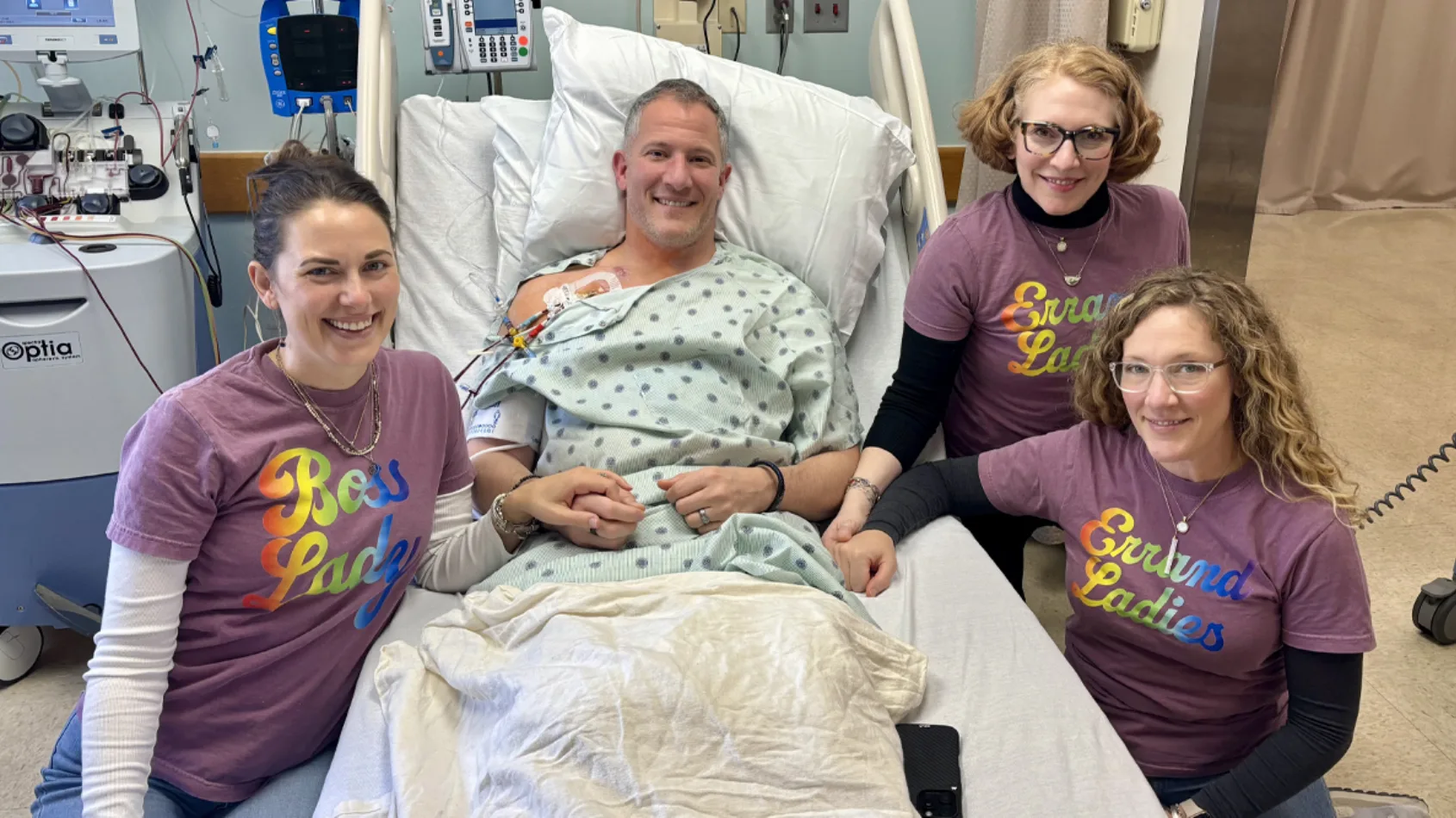
During that treatment, Roberts is supported by his wife and his sisters, Kendra Roberts, who lives in Oregon and Bethan Roberts, who lives in Bloomington. As they joined his wife Sara in support of his journey, the sisters wore t-shirts with the message: “Errand Ladies.” His wife wore a matching shirt: “Boss Lady.”
“Sara doesn’t like to ask for help, so we needed a label, so she understands the task,” said Bethan. They have also received an outpouring of support from their community in Bloomington.

