


July 10, 2025
From steel-toed boots to scrubs; endoscopy tech says work is about creating relationships
IU Health Methodist Hospital
By TJ Banes, IU Health Senior Journalist, tfender1@iuhealth.org
When Kenny Clay was laid off during a slumping economy, he turned to IU Health seeking employment. In 2011 he was hired in housekeeping in the emergency department at Methodist Hospital.
“Once I got the role, I started seeing how I could communicate with people and be unconsciously joyful. I continued to develop that,” said Clay. He is intentional about not calling his hire “a job.” He says he has always looked at life as a “role to play.”
Before coming to IU Health, Clay worked hauling scrap and odds and ends, wearing protective steel-toed boots.
“No matter what I’m doing it's important to develop work relationships. Everyone flows together,” said Clay, a native of the city’s westside and a graduate of Broad Ripple High School. As a team lead in housekeeping, Clay stepped up during the COVID pandemic, making sure supplies were delivered and employees were protected. But he didn’t stop there.
“If you open your ears in ER, you learn a lot and you find opportunities to help others – even if it’s just offering a kind word or a smile,” he said.
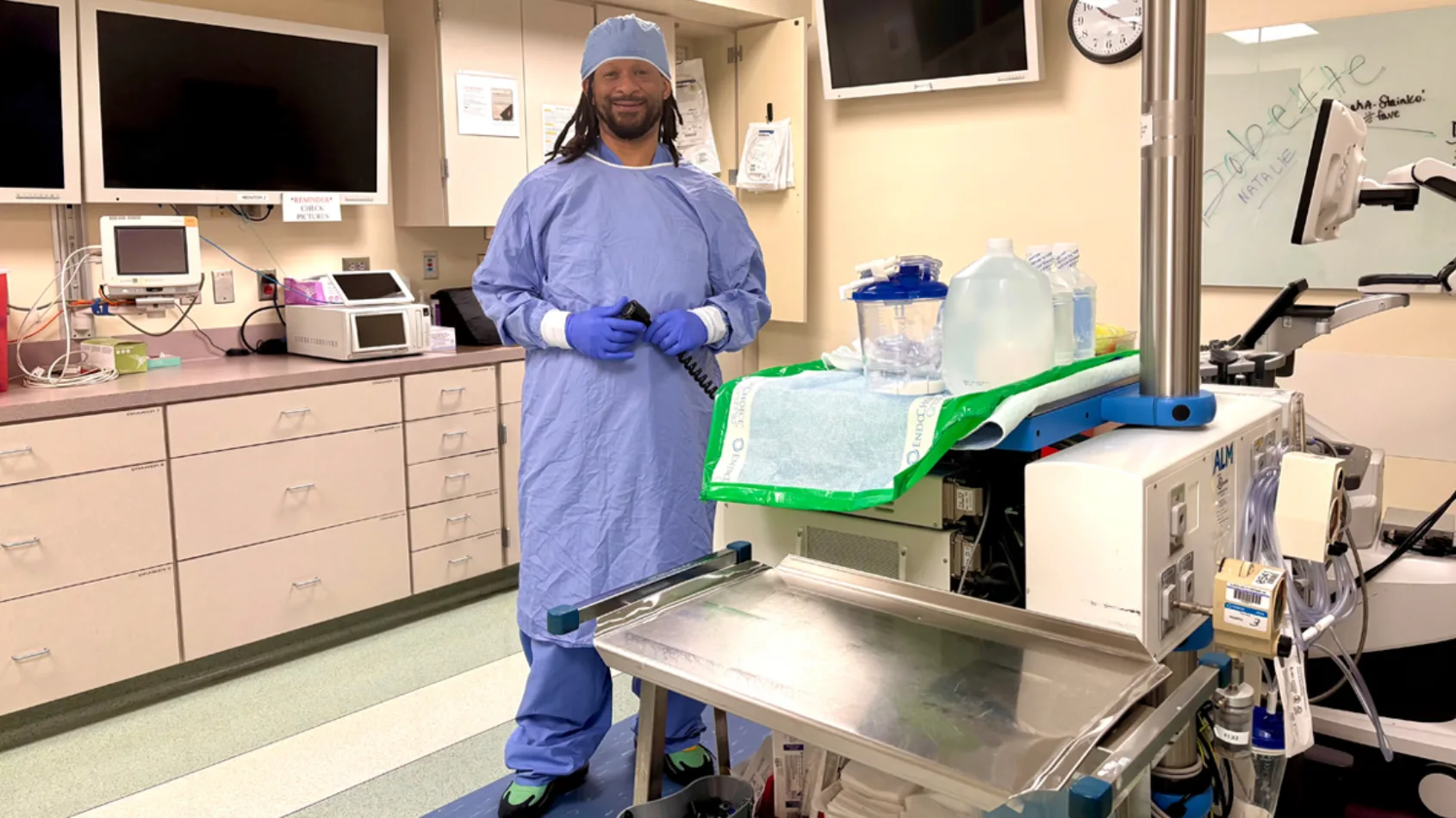
In March 2025, Clay switched his role with IU Health, wearing scrubs as an endoscopy technician.
“It’s funny to think I went from wearing steel-toed boots to scrubs, working in the heat of summer and cold of winter to a climate-controlled environment.” What remains the same is how Clay treats others.
Outside of work, Clay enjoys spending time with his family and cooking healthy meals. He is known at work for his spicy meatballs. It’s nothing for him to bring in a 10-quart crockpot and take it home empty.
In his current role, Clay enters a procedure room, makes sure it is stocked and set up, reviews the case and then assists the doctor in the room. That involves passing needles, and medication and operating machinery designed to assist in the procedure.
“When I was in housekeeping, I was cool with the trauma doctors. I watched and learned the way they adapt to situations. One day, a chaplain asked how I communicate so well with people, and I said, ‘we’re all similar so I treat everyone the same,’” said Clay.
“In my role now, I’m put in the room with some of the best doctors in the business and it’s like being put on a basketball court with Michael Jordan. I learn on the job, and I also work with what I know – relationship building.” He shares dozens of stories about how he’s helped calm nerves and made a difficult situation better.
He’s also learned from personal experience. When he was working at Methodist, Clay said he lost four family members to cancer. His father died while he was in the sixth grade and Clay was raised by strong women.
“My great-grandmother taught me I’m as important as anyone else. She taught me morals and Christianity,” said Clay. “As I evolved into a man, I wanted to be different and give back to others.”
