


May 04, 2026
Helping patients find their voice at every stage of life
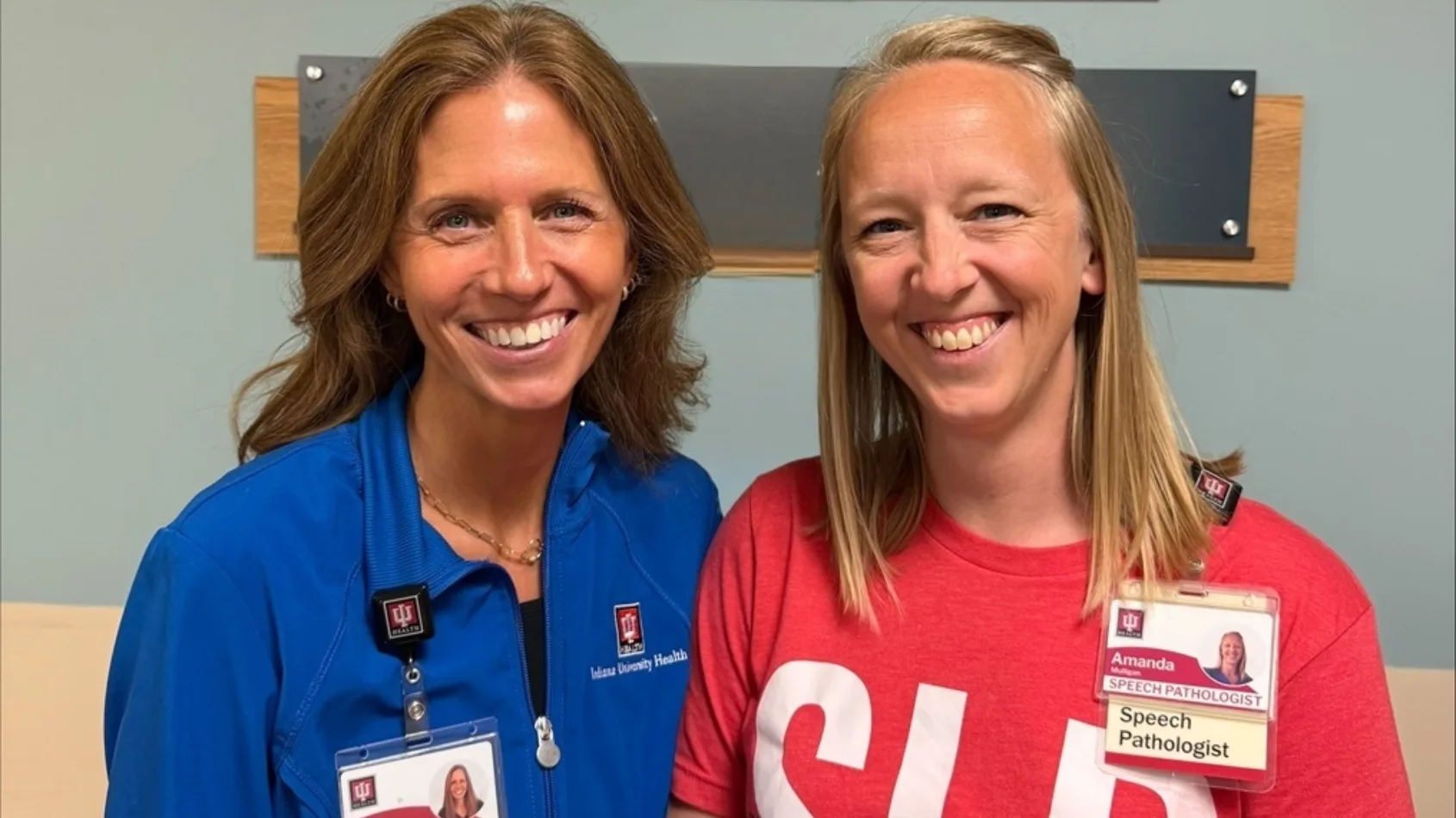
On any given day at IU Health Arnett, communication means far more than speaking clearly. It can be learning how to swallow safely after a stroke, helping a child transition to solid foods or supporting a patient as they find a new way to express themselves. For speech language pathologists Nikki Melchi and Amanda Mulligan, that work is deeply impactful.
Melchi, a speech language pathologist, provides therapy for patients across the lifespan. Her care spans speech articulation, expressive and receptive language, aphasia, traumatic brain injury, voice and swallowing disorders. She also works with patients navigating complex diagnoses such as Parkinson’s disease, ALS, stroke and head and neck cancer. “Most people think about children articulation when they think about speech pathology,” Melchi says. “However, we treat so much more.”
Mulligan’s work focuses on some of the earliest and most critical stages of development. As a speech language pathologist who specializes in pediatric feeding, she supports families from the day an infant is born through adolescence. Her role takes her to the Neonatal Intensive Care Unit, inpatient pediatrics, outpatient settings and pediatric video swallow studies. She addresses challenges such as coughing or choking, tube weaning, sensory difficulties and transitioning to solid foods. Her goal, she says, is “to support families in feeding their infants from the day they are born throughout adolescence.”
Both clinicians emphasize the importance of early intervention and individualized care, particularly during National Speech-Language-Hearing Month (May) and National Stuttering Awareness Week (May 9–15). Early therapy takes advantage of how the brain grows and adapts, while also empowering families to support long-term communication and feeding goals. “Introducing a specialized treatment plan as early as possible can empower families to support their child’s goals for communication and or feeding,” they note.
Melchi and Mulligan also stress that communication disorders affect more than speech alone. “Stuttering is more than just a speech disorder,” they say. “It affects individuals emotionally, socially and psychologically. Each person who stutters has a unique story to share, and a voice that deserves to be heard.”
Through personalized care and expanding services, including the addition of a new full-time speech language pathologist this summer, speech therapy services at IU Health continue to support patients and families at every stage of life.