


July 24, 2025
Hiker’s leg blood clot leads to cancer diagnosis
IU Health Simon Cancer Center
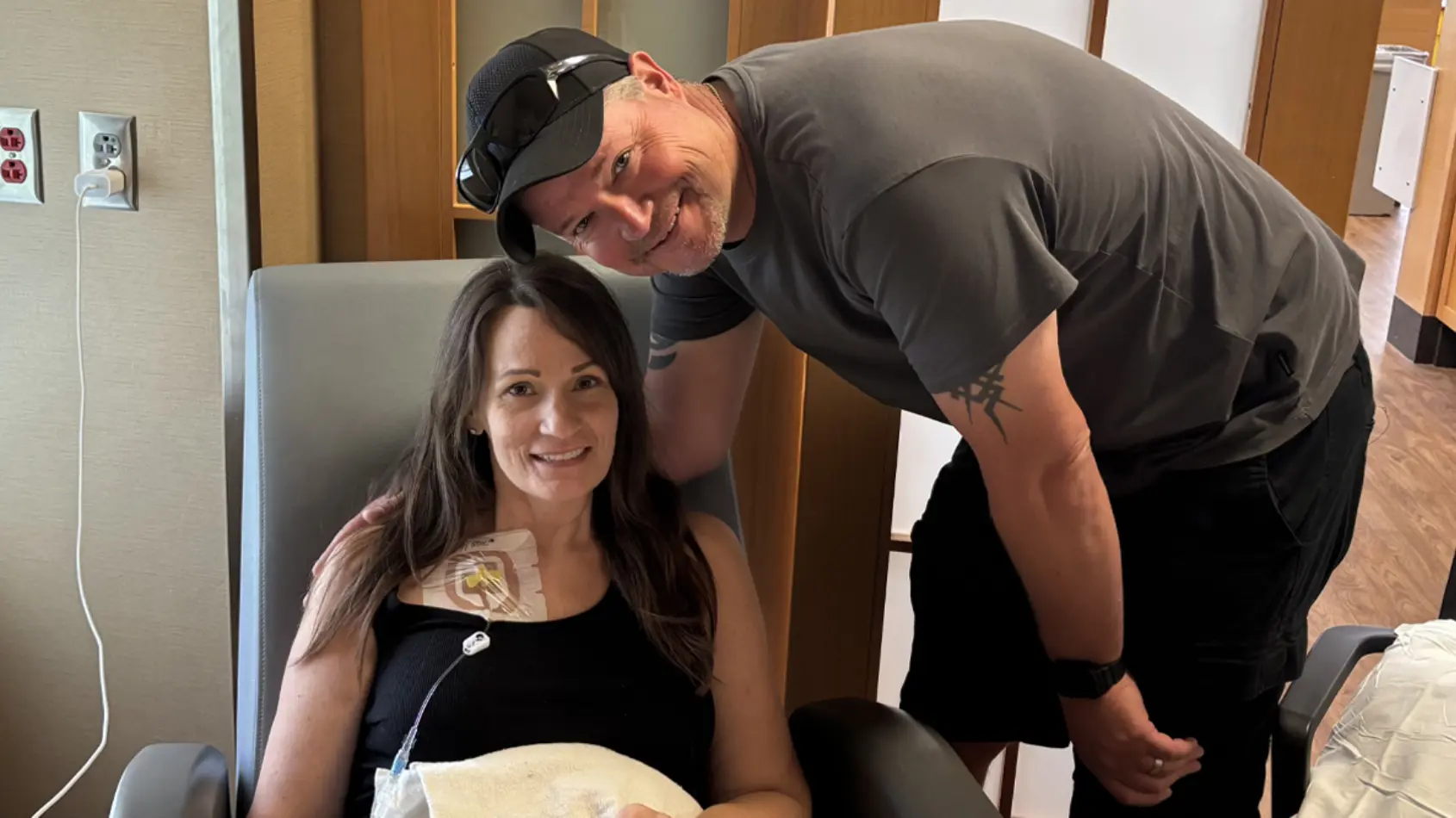
This mother was one year shy of the recommended screening for colon cancer.
By TJ Banes, IU Health Senior Journalist, tfender1@iuhealth.org
For years, Heidi Wilkinson has enjoyed family hikes – the hills of Tennessee, the ranges of Arizona, and the trails throughout Indiana. The mother of two adult children said many family memories were made around camping.
She was 10 years into her marriage to her husband, Jim, when they took a 10-mile hike with friends. He decided that was enough during that get-away.
“He said he’s put in a mile for every year of our marriage,” said Wilkinson, 44.
Now, years later her children admitted they hated hiking, but did it because “mom liked to.”
On her recent 24th wedding anniversary, Wilkinson and her husband reminisced about their lives together. They met through a friend, were married in a family church, where the attendants wore hunter green. They honeymooned in Florida but left early because it rained every day.
As they shared their story, the laughs were punctuated by tears. They didn’t expect to be celebrating more than two decades of marriage in an infusion pod at IU Health Simon Cancer Center. But on June 5, after visiting a doctor for a blood clot in her leg, Wilkinson underwent additional testing. Bloodwork indicated her liver enzymes were high, and a scan showed a mass. She was diagnosed with liver and colon cancer.
A resident of Decatur, in northeastern Indiana, Wilkinson graduated from Heritage High School in Allen County. After high school she attended IU Fort Wayne and works as a dental expanded assistant in restorative practice. Besides the birth of her children, she’s never been hospitalized or ill.
“I’ve always kept up with my health care like mammograms and preventative health,” said Wilkinson, who is in the care of Dr. Laura Vater. Wilkinson said she believes the mass in her colon would have been detected during a colonoscopy.
The American Cancer Society recommends that people at average risk of colorectal cancer begin regular screenings at the age of 45. This can be done either with a sensitive test that looks for signs of cancer in a person’s stool (a stool-based test), or with an exam that looks at the colon and rectum (a visual exam). “Average risk” is considered people who do not have: A personal history of colorectal cancer or certain types of polyps; family history of colorectal cancer; a personal history of inflammatory bowel disease (ulcerative colitis or Crohn’s disease); a confirmed or suspected hereditary colorectal cancer syndrome, such as familial adenomatous polyposis (FAP) or Lynch syndrome (hereditary non-polyposis colon cancer or HNPCC); or personal history of getting radiation to the abdomen (belly) or pelvic area to treat a prior cancer.
Wilkinson and her husband make the two-hour trip to IU Health Simon Cancer Center every week where she is undergoing chemotherapy.
“I am thankful for everyone who has been there to support us – my family and work friends,” said Wilkinson. “We are looking forward to our daughter’s wedding in September and I just want this mass to be gone so I can be around as long as I can.”
