


September 16, 2026
IU Health expands access to advanced endoscopic spine surgery across southern Indiana
IU Health Bloomington Hospital
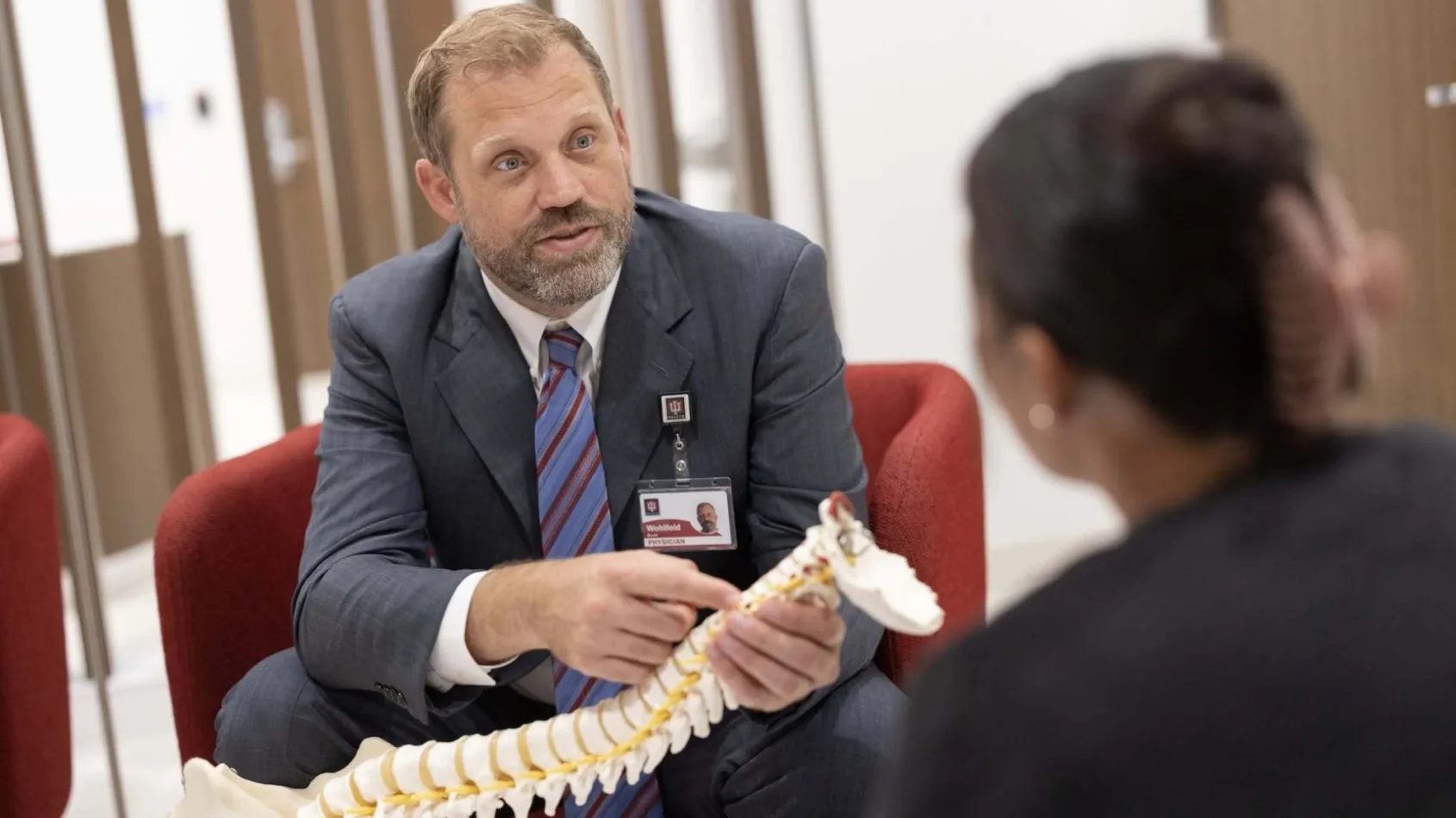
Considering endoscopic spine surgery? Here's what patients should know.
When back or neck pain begins affecting the ability to enjoy everyday life, it's natural to start looking for answers.
While physical therapy, medications, injections and other nonsurgical treatments can often provide relief, they don't work for everyone. In some cases, surgery is the best option.
Endoscopic spine surgery is an ultra-minimally invasive technique that uses a specially designed instrument: the endoscope. This allows surgeons to view and reach small areas of the spine without need for the large incision required for traditional spine surgery.
Though the procedure has gained increasing attention in recent years, IU Health Bloomington neurosurgeon Bryan Wohlfeld, MD, has been performing endoscopic spine surgery since 2013.
Looking beyond the incision
When patients hear the term "minimally invasive spine surgery," they often focus on the size of the incision. While a smaller incision is beneficial, Dr. Wohlfeld shares that another key benefit is the ability to see more clearly.
"For years, one of the limitations with less invasive surgery was having enough light and enough room to work," said Dr. Wohlfeld. "With modern endoscopic technology, we're able to bring the anatomy we're working on right to the forefront and view it on a high-definition screen."
This enhancement helps surgeons work with greater precision and minimize disruption to surrounding muscles and tissues.
A surgeon's early commitment to endoscopic spine surgery
Dr. Wohlfeld first performed endoscopic spine surgery at the University of Texas Southwestern in 2013. As his interest in the technique grew, he became involved in teaching other surgeons as a faculty instructor for an endoscopic spine surgery company.
His training also took him overseas to Germany, where he spent time learning from some of the world's early pioneers in endoscopic spine surgery.
"One of the advantages of having started early is that I've had the opportunity to work through the learning curve and really understand what endoscopic surgery is best for and where other approaches may make more sense," he said.
That experience has helped him develop both his skills and a thoughtful approach to patient selection.
Why patients are interested in endoscopic spine surgery
For selected patients, endoscopic spine surgery may offer several potential advantages, including:
- Smaller incisions
- Less disruption of muscles and soft tissues
- Less postoperative discomfort
- Outpatient treatment for many procedures
- Faster recovery and return to daily activities
Every patient is different and recovery depends on factors including the condition being treated, overall health and the specific procedure performed.
Expanding what's possible
As technology continues to evolve, so do the uses of endoscopic spine surgery.
Dr. Wohlfeld has used endoscopic techniques to treat increasingly complex conditions, including certain thoracic disc herniations and cervical decompression procedures that historically required larger operations and greater tissue disruption.
"One of the exciting things about this field is that it's constantly moving forward," he said. "We're always looking for ways to help patients achieve better outcomes and recover more quickly."
What recovery looks like
Recovery varies based on the condition treated, the area of the spine involved, the specific procedure and your overall health. Many endoscopic spine procedures are performed as outpatient surgery, although some patients may need an overnight stay.
Is endoscopic spine surgery right for you?
If you have chronic low back pain, failed back surgery syndrome or have experienced degenerative changes in the lumbar spine, this option may be able to help you alleviate pain and regain your function again. Consult with your healthcare provider to determine the best treatment plan for you.

