March 19, 2026
‘No one talks about bathroom habits:’ Mom, 31, diagnosed with colorectal cancer
IU Health Simon Cancer Center
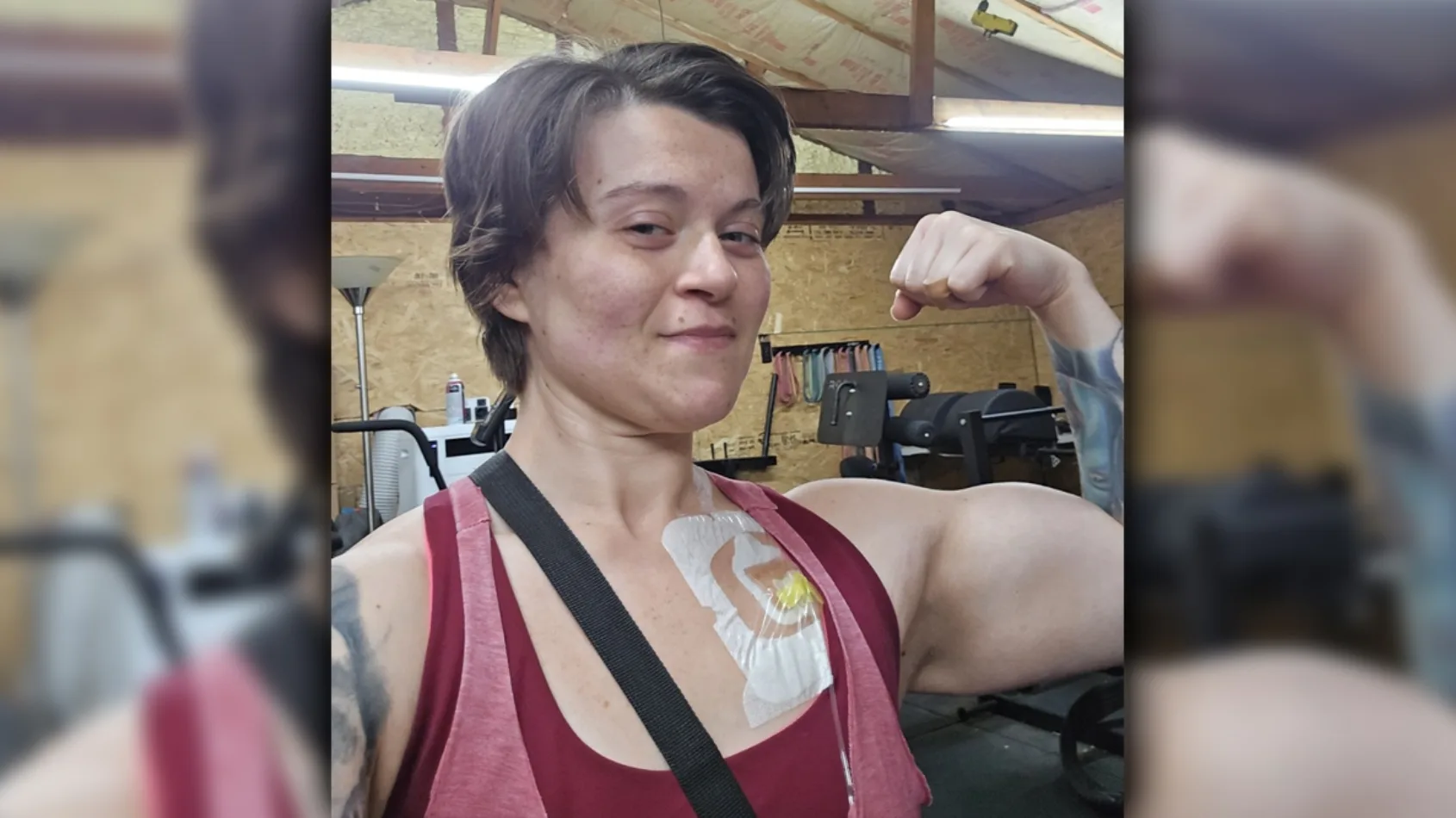
During Colorectal Awareness Month this woman speaks out about hidden symptoms.
By IU Health Senior Journalist, TJ Banes, tfender1@iuhealth.org
She was a personal trainer who studied biology with her eye on med school. After multiple OB/Gyn visits, Amber Glass put her science background to work. She knew something was wrong with her body, but she didn’t know what.
“I didn’t realize the first symptom was a symptom of colorectal cancer at all. I didn’t think about it until after I was diagnosed,” said Glass.
For about a year and a half (2023-2024) Glass experienced pelvic pain. She describes it as “very sharp, like a stab” to the point she would visibly jolt in her seat. “As a female I thought it might be something cervical, uterine, or ovarian. I went to the OB/Gyn about 10 times. “They usually did a pelvic exam where they would look and not see anything abnormal, feel inside and didn’t feel anything abnormal and then they’d do an ultrasound and every single time it would all come back fine.”
Glass has a master’s degree in anatomy and said she was focusing on the symptoms as they relate to a female body. “There are so many areas that could create that pain – bladder, uterus and kidneys.”
It wasn’t until last spring when she had an intestinal infection that the pieces began falling into place. She underwent a Gastrointestinal Pathogen Panel (GPP) that detects bacteria, viruses and parasites through a stool sample. “My inflammatory level was 32 times the normal amount. Even with an infection that was extremely high.” She finished an antibiotic and for a time everything returned to normal.

“Then a month later, things changed. They basically went from regular stools to completely unformed and nothing but blood and mucus,” said Glass, 31, who has been married to her husband, Matt since August of 2020. They have one daughter who is six.
It was her gastrointestinal doctor who suggested Glass get a colonoscopy and endoscopy.
The American Cancer Society recommends that people of average risk of colorectal cancer start regular screenings at age 45. This can be done either be a stool-based test, or with an exam. People are considered at “average risk” if they do not have a history of polyps, a family history of colorectal cancer, a personal history of inflammatory bowel disease, a confirmed or suspected hereditary colorectal cancer syndrome or a personal history of receiving radiation to the abdomen or pelvic area.
Glass was not considered a high risk for the disease, but on Oct. 25, 2025, after a colonoscopy at IU Health North she heard the words: “This is never easy, but this is cancer.”
Glass said her doctor showed her a packet of pictures and described what was referred to as a “gatekeeper,” basically causing an obstruction. Several appointments followed with a general surgeon, oncologist, and radiation oncologist. She had an MRI and PET scan and started chemotherapy.
A former resident of Louisville, KY., Glass became interested in health and fitness when she was in high school. Her discipline resulted in a 100-pound weight loss. She went on to receive a personal trainer certification and worked at a local gym. After she witnessed a participant suffer cardiac arrest, Glass became keenly interested in biology. She received her degree and planned to go into medicine. At the time of her diagnosis, she had applied to medical school and had worked in various hospital positions, landing as a tech in the microbiology lab at IU Health.
Since her diagnosis, she has been recovering from chemotherapy in preparations for surgery. She will receive a low interior resection in the care of Dr. Bruce Robb.
Throughout her chemotherapy at IU Health Schwarz Cancer Center, Glass has been in the care of Dr. Hillary Wu. The chemotherapy has worked to shrink the tumor – initially, 6.3 centimeters to 2.1 centimeter.
“Treatment of colorectal cancer requires a multidisciplinary approach, with medical oncology, surgical oncology, radiation oncology, and gastroenterology, among other specialties. New development on treatment options is evolving constantly. With new understanding of the molecular changes driving the cancer development, targeted therapies are approved or tested in clinical trials,” said Dr. Wu. She added that younger patients are typically in better health compared to older patients with the same diagnosis.
“In contrast to the decreasing incidence of colorectal cancer in older populations, the incidence has nearly doubled in younger adults since the early 1990s. Approximately one in 10 new diagnoses are now made in individuals 50 years or younger,” said Dr. Wu. The risks are calculated by age and family history, yet three in four patients with early on-set colorectal cancer have no family history.
“Rapidly increasing incidence rates in younger persons could result from generational differences in diet, environmental exposures, and lifestyle factors. We review epidemiologic trends in colorectal cancer, data on genetic and non-genetic risk factors, and new approaches for determining risks. These may identify individuals likely to benefit from early screening and specialized surveillance.”
Dr. Wu suggests some preventative measures may include exercise, treatment of diabetes and inflammatory bowel disease, a balanced diet with adequate fibers, and a decrease in red meat consumption. She also suggests avoidance of smoking and decreases in alcohol consumption.
Typical symptoms vary but may include bleeding, constipation, diarrhea, changes in stool patterns, bloating, pain at rectal area, abdominal pain, fatigue and weakness.
“I’m not sure if others would have pursued answers the way I did,” said Glass. “I’ve learned from my GI and oncologists that we are ashamed to talk about bathroom habits, so some people don’t get diagnosed until it has spread.”