


August 13, 2025
Wife’s paired kidney gives doctor a second chance
IU Health University Hospital
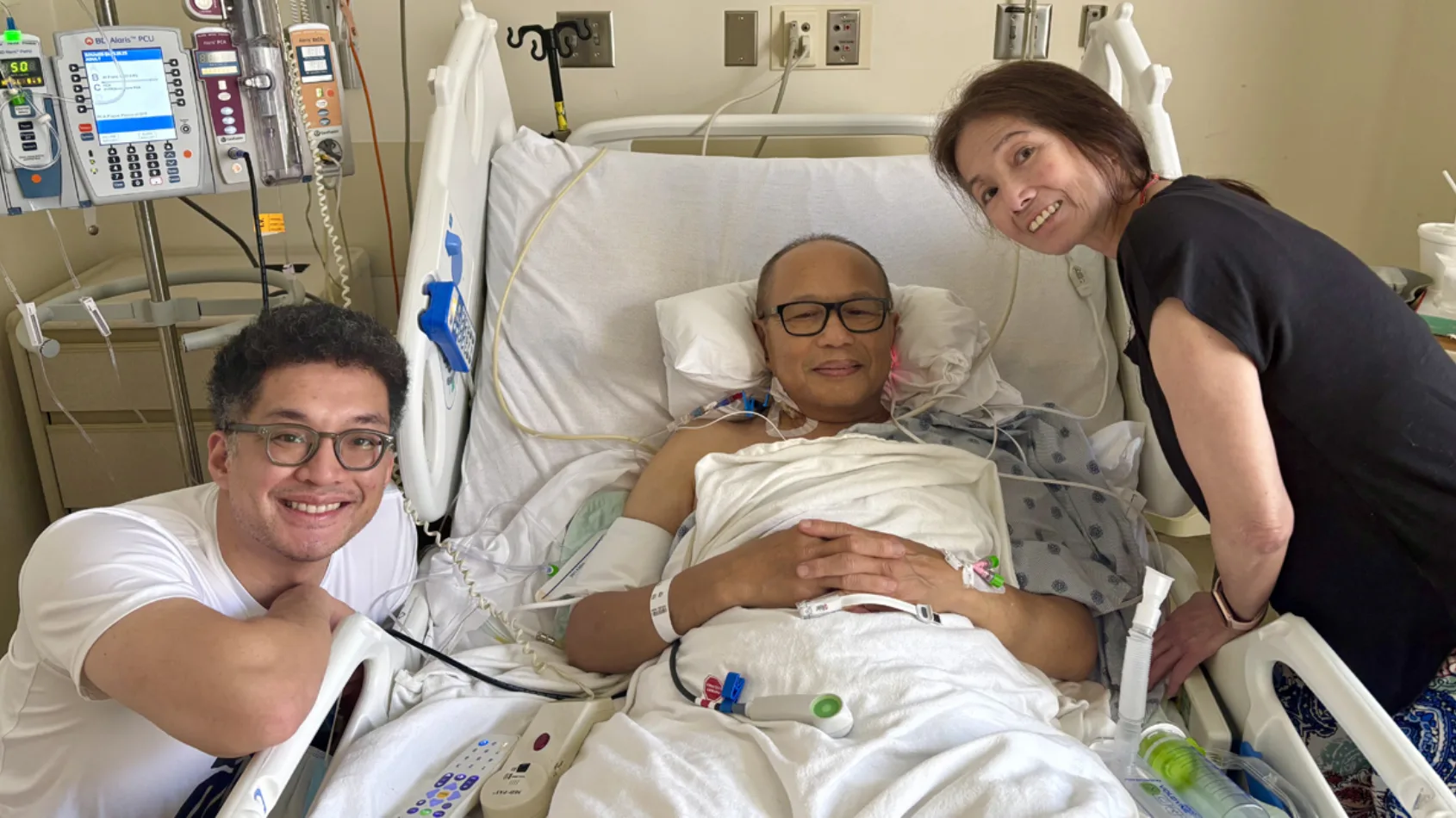
When Thuy Than was told she wasn’t a viable match for her husband’s kidney transplant, she didn’t give up.
By TJ Banes, IU Health Senior Journalist, tfender1@iuhealth.org
After four decades of marriage, Thuy Than wasn’t taking “No” for an answer when her husband’s health was at stake.
“At the beginning, I was rejected due to underlying health issues dating back to 2016,” said Than, 69. “I said, ‘no, I won’t give up,’ so I went to my provider to have all the testing for my condition.” When she learned she was clear, she moved forward with the evaluation to see if she was a viable kidney donor.
Her husband, Alexander Ton, also 69, was diagnosed years ago with IgA nephropathy, also known as Berger’s disease. The kidney disorder is characterized by a buildup of immunoglobulin A (IgA) antibodies in the kidney tissue. Eventually, the inflammation damages the kidneys.
Ton grew up in Vietnam and received a scholarship to attend college in Taiwan where he studied agricultural engineering.
“When communism took over in 1975, I didn’t want to go back to Vietnam, so I applied to come to the US,” said Ton. In 1976 he moved to Sacramento, Calif. And studied chemical engineering at UC Davis Medical Center. He then went on to study medicine at Ross University (Barbados), and completed his residency in Terre Haute, Ind.
It was after his move to the United States, that Ton learned of his kidney diagnosis. He was able to monitor and manage the symptoms for several years, finally getting listed for transplant.
“We knew there would probably be a waiting time of three to five years,” said Ton’s wife. The couple, married 40 years, are the parents of two children. Their daughter, Kimberly Ton, lives in California and works as a civil engineer. Their son, Anthony Ton, graduated from Butler University, where he studied pharmacy, and went on to study medicine at St. George’s University, Grenada, West Indies. Like his father, Anthony Ton works in family medicine.
“Our son wanted to be a kidney donor, but we felt he was too young,” said Than. “I wanted to do it.”
At IU Health many patients needing transplants receive both kidney and liver from living donors. Living kidney donors help give renewed health to people experiencing kidney failure. Living donors reduce or eliminate the need for patients to start dialysis and a healthy kidney from a living donor can function better and last longer than a kidney from a deceased donor.
A living kidney donor isn’t necessarily related to the recipient. Compatibility is based on blood type and tissue typing. Age and size are also taken into consideration. If a healthy donor is incompatible with the intended recipient, the donor may opt to be part of paired donation. Also known as “kidney swap” recipient /donor pairs are matched according to compatibility. Over the years, IU Health’s kidney transplant team has performed several paired donations. Some chains have included multiple people.
When Than was not a compatible donor for her husband, she opted to donate her kidney to a stranger. In turn, her husband was paired with another living donor.
On April 15, Than donated her kidney. She was in the care of IU Health’s Dr. John Powelson. On July 28, her husband was in the care of Dr. William Goggins and received his new kidney.
As he recovers, Ton said he is eager to get back to the things he loves most – walking five miles a day, eating his wife’s Vietnamese dishes, and continuing to care for his patients throughout Vigo County.
When asked about his care at IU Health, Ton offered a big smile and a “thumbs up.”
“Everyone has been personal, friendly and compassionate.”


