September 30, 2025
A patient named ‘Rita’ is grateful for a doctor named ‘Rita’
IU Health Simon Cancer Center
By the time Rita Mawhorter got to IU Health Simon Cancer Center she was seeking answers and looking for solutions to her cancer diagnosis.
By TJ Banes, Senior Journalist, tfender1@iuhealth.org
Rita Mawhorter said her symptoms started back on Nov. 11, 2024, when she saw a white spot on the back of her throat. A resident of Columbia City, Ind. she initially visited an after-hours clinic closer to her home.
“They took a look at it and said it would go away but I still had a sore throat,” said Mawhorter, 65. A month later she visited an ENT doctor and was told to come back in six weeks. Days later she began having random fevers and was vomiting. She returned to the clinic and was put on an antibiotic.
“I told my husband, ‘I need to go to the hospital.’ They ran tests and I was septic with a fever of 103 degrees,” said Mawhorter, who has been married to her husband, Michael for 42 years.
The Mawhorters met when Rita was working at the Purdue Veterinary School and Michael was in his senior year studying veterinary medicine. They had a 3-year-old and a 3-month-old when they opened a veterinary clinic in Columbia City, Ind. They now have three adult children and four grandchildren.
After so many years of marriage, Michael Mawhorter knew something was seriously wrong when his wife said she needed to go to the hospital.
“They did some blood work and ultrasounds and found lesions on my lungs. The doctor said I had cancer and walked out of the room. It was very difficult,” said Rita. She then went to a hospital in Fort Wayne where more biopsies were done on her throat, lungs, liver, stomach and bone marrow. “Everything kept coming back as necrotic tissue,” said Rita. Necrotic tissue describes dead or dying cells, often caused by insufficient blood supply, infection, trauma, or radiation. After two weeks in the Ft. Wayne hospital, Rita Mawhorter came to IU Health Simon Cancer Center.
“I came here because they couldn’t figure out what it was,” she said. “I had a lung biopsy with Dr. (Francis) Sheski and when I told him about the white spot in my throat, it all came together.” Mawhorter learned that her specific diagnosis was Peripheral T-Cell lymphoma (PTCL). The rare and aggressive type of non-Hodgkins’s lymphoma develops in mature T-cells and represents 10-12 percent of all lymphomas.
Once she had a diagnosis, Mawhorter was introduced to IU Health’s Dr. Rita Assi with the Hematology Clinic at IU Health Simon Cancer Center.
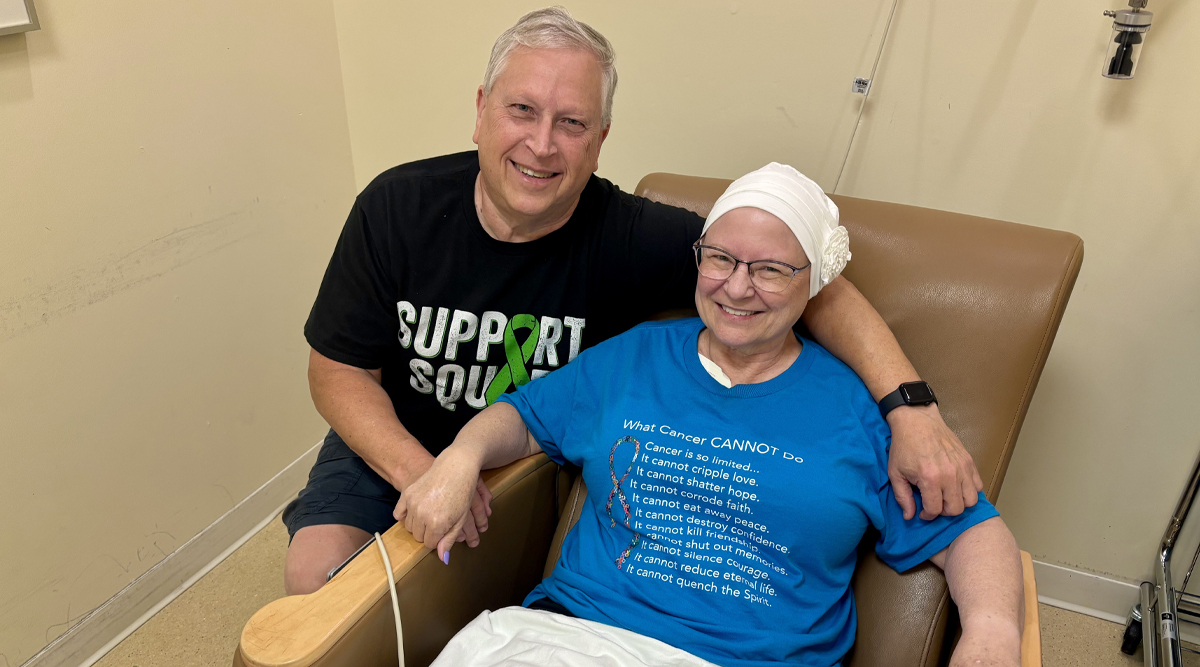
“Well, we’re both named ‘Rita’ so that was a plus, and she is just so forthcoming with information, very positive and pleasant. I felt comfortable with Dr. Assi and that she has my best interests at heart,” said Mawhorter. After completing six rounds of chemotherapy, Mawhorter had a PET scan to access the success of the treatment. She was accompanied by her husband who wore a shirt with the message: “Support Squad.”
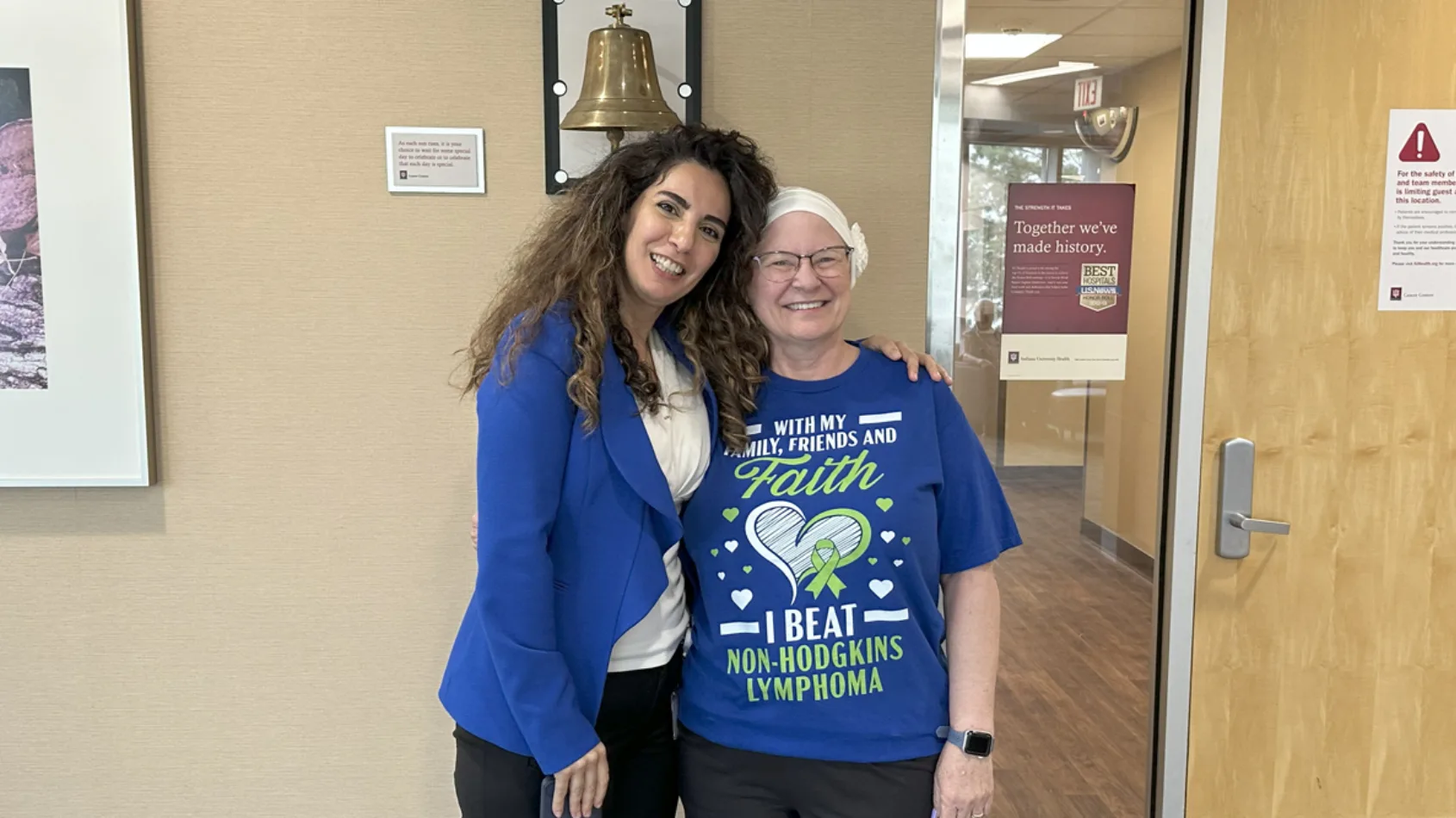
After her scan, the couple met with Dr. Assi and learned that her treatments worked. She stood next to Dr. Assi wearing a smile and a shirt with the message: “With my family, friends, and faith, I beat Non-Hodgkin’s Lymphoma.” Then she rang the bell to signal an end to her treatment.

As they look ahead to what is next, they are grateful for her health and their retirement from the veterinary practice. One of the last trips they took together was to the Grand Canyon and Zion National Park. They’ve talked about other trips – to Italy or maybe Costa Rica.
“For now, we are avid readers, and we love being with our kids and grandkids. That’s such a blessing,” said Mawhorter.