


May 18, 2026
From trains to air travel: IU Health's lifesaving legacy at Indianapolis Motor Speedway
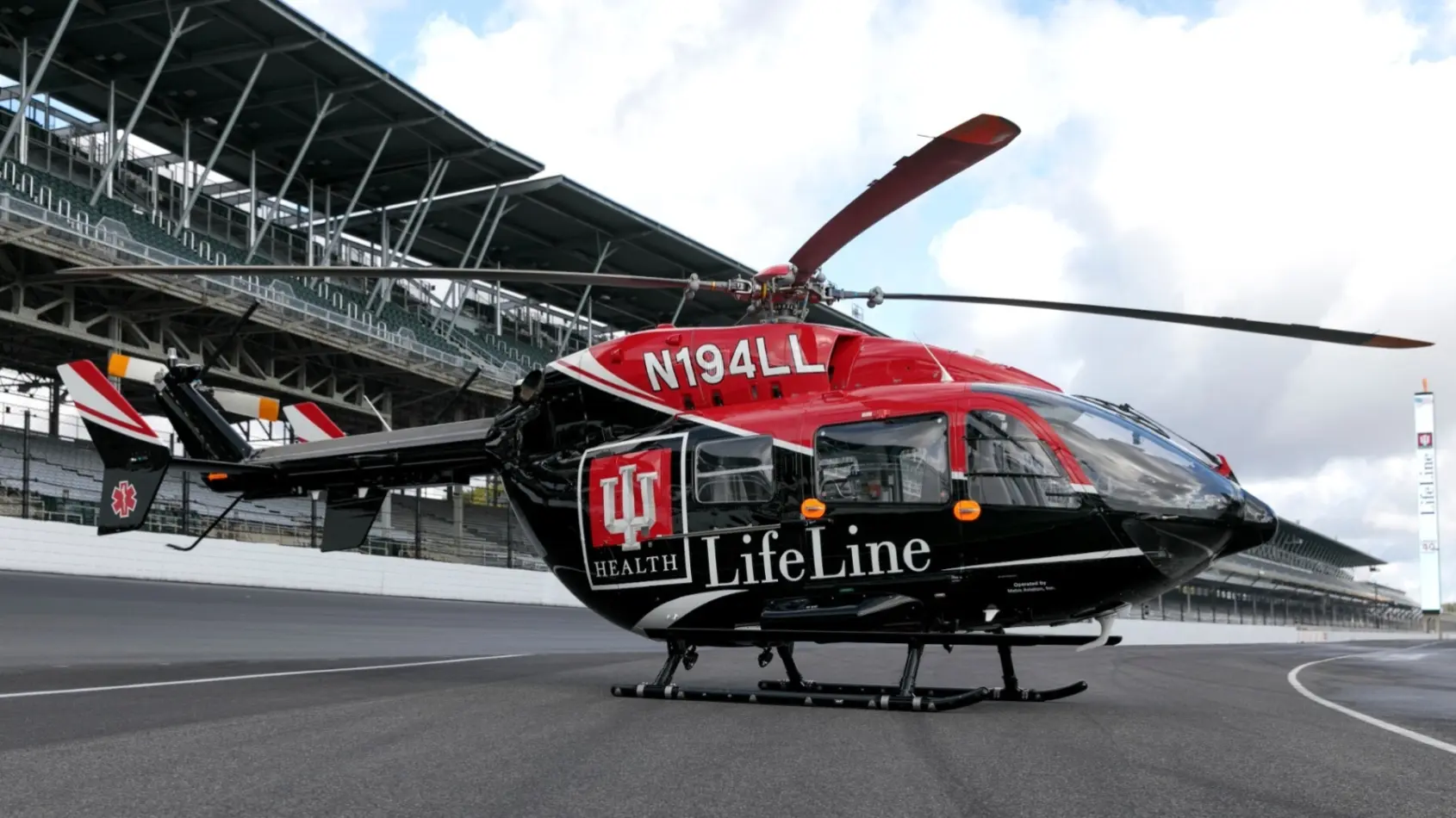
IU Health has a long and rich history supporting the Indianapolis Motor Speedway’s drivers, spectators and staff during racing season and at the annual Indianapolis 500 race. For over a century, IU Health has been caring for most health issues that arise at the speedway with advanced medical expertise and state-of-the art technology. IU Health’s LifeLine team supports critical care patients via ambulance or helicopter today, but used to rely on train tracks to transport patients to and from the racetrack.
“When LifeLine started in 1920, critical care patients were transported by train from the Indianapolis Motor Speedway (IMS) to Methodist Hospital,” says Melissa Cash, vice president, LifeLine and Virtual Care. “It wasn’t until 1970 when we had our first use of a helicopter to rapidly transport patients from IMS to Methodist.”
On a typical race day, IU Health staffs emergency medicine physicians, an orthopedic surgeon, a neurosurgeon, a trauma surgeon, nurses, paramedics, emergency medical technicians and general staff at the Emergency Medical Center on-site for quick action. For more serious cases, LifeLine facilitates care and transfers to Methodist Hospital’s Level 1 Trauma Center, located four miles from the Indianapolis Motor Speedway. In 2015, this proximity allowed IndyCar driver James Hinchcliffe to be transported via LifeLine ambulance from the track to IU Health Methodist Hospital, just six minutes after a crash during a practice run. The crash caused serious injuries and massive blood loss. Through the quick action and expert care provided by LifeLine and IU Health’s physicians and nurses, Hinchcliffe made a full recovery from his life-threatening injuries.
"You don’t have to be a driver on the track to receive life-saving, critical care from our incredible and qualified LifeLine team,” says Cash. “We’re honored to serve this motorsports community, and the gratitude from the IMS and race fans is felt.”