


January 06, 2026
IU Health’s first spine nurse navigators support patients, every step of the way
IU Health West Hospital
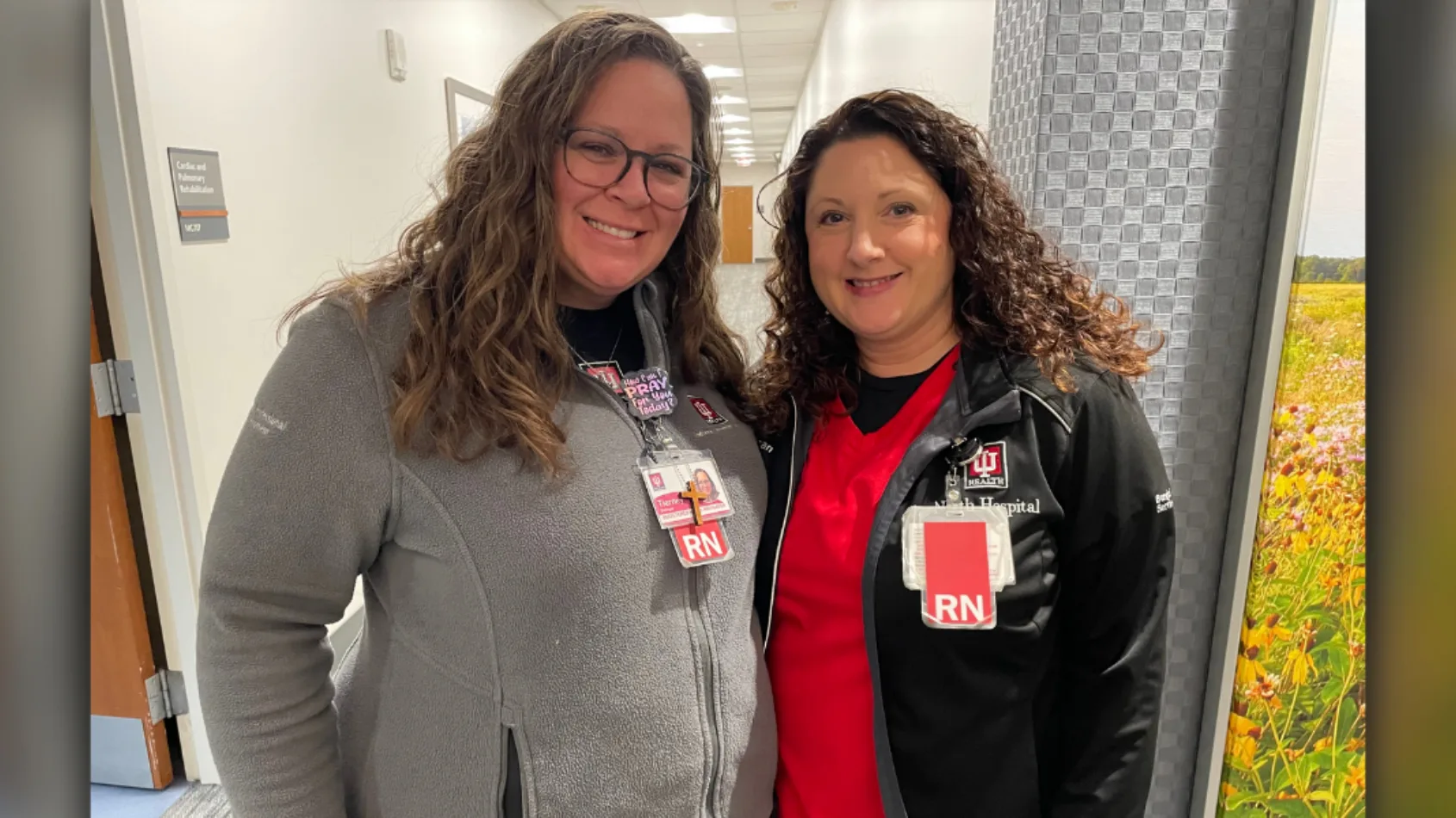
Tierney Dininger and Susan Paulick are the first hospital-based spine nurse navigators within the IU Health system, providing quality and personalized care to those seeking spine pain relief at IU Health North and West hospitals.
By Charlotte Stefanski, cstefanski@iuhealth.org, writer for IU Health's Metro Region
Statistics show that 80 percent of the population will, at some point, experience back pain. When the back pain becomes severe or chronic, some patients may turn to surgery.
To ensure patients are supported through that process, IU Health North and IU Health West were the first to launch the hospital-based spine nurse navigator role in the IU Health system in 2024.
Spine nurse navigators focus heavily on patient and team member education and serve as a connection between the outpatient clinic and the surgical teams, with Tierney Dininger at West Hospital and Susan Paulick at North Hospital.
“This role is a great balance between patient care and education, which I love,” Dininger explains. “I wanted to grow more, do a little more leadership, teach—all of those things.”
“The autonomy of nursing, the ability to be flexible, and have different avenues to go through is what drew me in,” Paulick adds.
IU Health's growing spine program
In 2024, leaders at IU Health North and West saw a need for more spine surgical services in the Indianapolis suburban area. Efforts began to grow the program and recruit surgeons.
With that growth came a need for extra support, notes Roshni Bag, who leads service line efforts for spine care.
“There was a critical need, given the complexity of the service, that we had resources to manage the full spectrum of patient care—from when the patient is first seen as an outpatient, to when they come in to get the surgery, and then when they come back into the clinic to do their post-surgical evaluation,” Bag says. “We wanted to have a dedicated team that ensured patients felt supported and their care was coordinated through every step of that journey.”
That need created the hospital-based spine nurse navigator role—which is now being adopted in other locations across the IU Health system.
Dininger started out as a certified surgical technologist and joined the West team in 2015. She graduated from nursing school in 2020 and worked in the hospital’s operating rooms (OR) for a few years before taking on a nursing professional development role in peri-operative services.
Paulick joined North as a registered nurse in 2017 and worked in the OR for several years. Spine surgical cases interested her, and eventually, she became an ambulatory nurse for IU Health’s Spine program, located near the hospital on Pennsylvania Parkway.
When the spine nurse navigator roles opened in 2024, Dininger took the role at West that August and Paulick in October.
Now one year after launching the role, Bag notes that one meaningful impact from the spine nurse navigators is in tracking average length of stay.
“They’ve been identifying opportunities to partner with the North and West teams to support earlier, clinically appropriate discharge,” Bag says. “This has led to more intentional pre‑operative work, ensuring patients are optimized and fully prepared before they ever step into the OR, which contributes to smoother recoveries and a more positive overall experience.”
Support is a phone call away
Most patients Dininger and Paulick see are suffering from chronic back pain.
“It's not only physical pain, but psychological,” Dininger explains. “We see a lot of patients who need extra support.”
That begins with education before the procedure, with navigators meeting every surgical patient. They ask about the patients’ home life and support systems, because recovery can be tough. Then, they discuss medications and correct protocols prior to surgery.
When patients are admitted for the procedure, Dininger and Paulick round about twice a day, ensuring everyone is on the same page. Once patients are ready to go home, the navigators provide clear instructions and answer questions. But it doesn’t stop there—patients can reach out to them any time after surgery.
“We both have an open dialog with them. They can reach us anytime, once the process starts, and even after surgery,” Paulick says. “I usually call a few days after surgery, just to make sure they understand the instructions, checking on how their pain is at home and that there are no issues.”
Finding their purpose
As Dininger and Paulick develop and define what it means to be a spine nurse navigator, they’ve found plenty of purpose in their first year.
The most rewarding aspect has been the positive impact the role has left on their patients.
“What I get out of it is that these patients are improving in some way. They physically feel better,” Paulick says. “Emotionally, you can tell that a weight has been lifted.”
Dininger recalls one patient who initially met with Paulick at IU Health North for their consultation due to the hospital’s proximity, but had surgery at IU Health West. Knowing that North Hospital was closer, Dininger scheduled all the patient’s post-surgery appointments there with Paulick.
“They were like, ‘Susan was so helpful. I love her.’ It’s really nice when you hear them say thank you for the support,” Dininger says. “Just knowing they have us, someone they can depend on and to ask questions, and then hearing their responses afterward of thankfulness, that's probably the most rewarding.”
Spine care—the IU Health way
As IU Health North and West hospitals continue to build their spine service lines and offer more care options, Dininger and Paulick want the community to know they’re here to help.
“We have a really wonderful team. Everybody cares a lot,” Dininger says. “We're very thorough and we just want to make sure that the patients are well taken care of.”
Paulick adds that the team will do whatever is best for the patient—whether it be surgery or exploring other care options.
“We really do pride ourselves in quality of care, in making sure patients are well informed and well equipped,” Paulick says. “We want to do what's best interest of the patient and their health.”
To learn more about IU Health’s Spine program, visit https://iuhealth.org/find-medical-services/back-spine-care
Pictured from left to right: Tierney Dininger and Susan Paulick

