December 16, 2025
Grateful patient thanks IU Health North team for seamless cardiac care
IU Health North Hospital
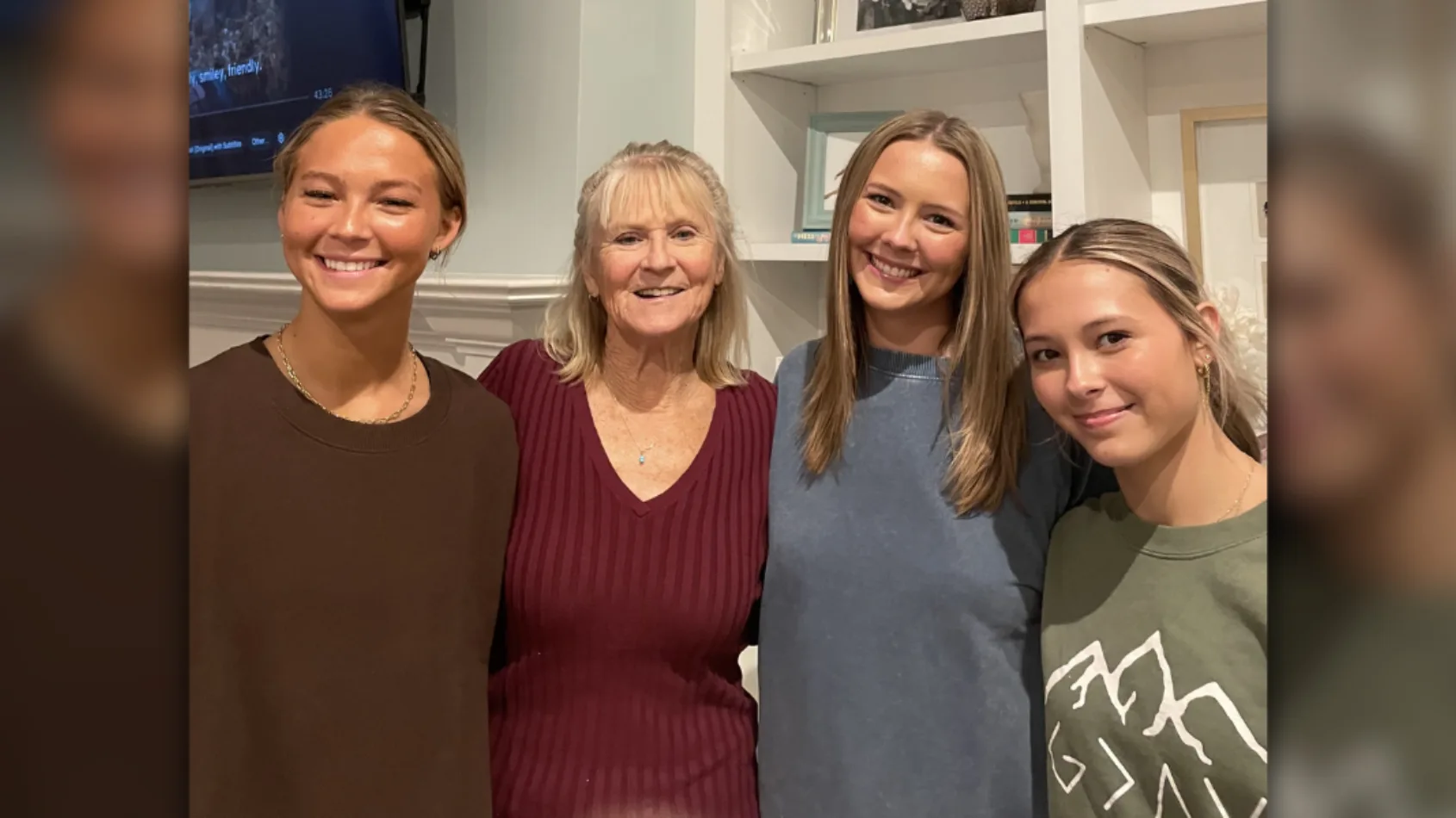
When Karol Clark, a 72-year-old retired nurse, came in for her annual wellness exam at IU Health North, she wasn’t expecting to have a heart attack. Thanks to the quick thinking of physicians and team members, she made a full recovery.
By Charlotte Stefanski, cstefanski@iuhealth.org, writer for IU Health's Metro Region
Two days before her annual wellness exam, Karol Clark took her grandchildren to a dinosaur exhibit. The weather was cold for March, and as the family scurried back to their car, Clark found herself out of breath.
“It felt like there was an elephant on my chest,” Clark recalls. “I stopped and it went away, so I thought it must’ve been the cold.”
The next day, the 72-year-old retired nurse headed to her local gym to workout. She noticed some heartburn and took Tums, which helped. But as she took a shower the following day, the pressure on her chest returned.
Clark (pictured above, second from left) was scheduled to see her primary care physician, Dr. Sarah Lackerman, MD, at IU Health North Hospital that day, where she could bring up the symptoms.
“Never did I think it was a heart attack,” Clark says.
An unexpected emergency
Once Clark explained her symptoms, Lackerman suggested she head down to the hospital’s Emergency department.
Clark recalls feeling the tightness in her chest as she made her way to the unit. She made sure to call her family before heading in.
Team members immediately began checking Clark’s vitals and hooked her up to the electrocardiogram (EKG) machine, which monitors the heart's electrical activity.
Shortly after, a physician confirmed that Clark was having a heart attack and explained she needed to go to the cardiac catheterization lab.
“I had four nurses working on me—one putting an IV in my right arm, one on the left, another changing my clothes and the fourth was putting EKG leads on me,” she says.
Twenty-five years ago, Clark herself was a clinical research coordinator in interventional cardiology, so she was familiar with the cath lab.
As she entered the procedure room, she remembers her care team being completely calm—they answered her questions and explained what was happening during the procedure.
While Clark was on anesthesia for the initial insertion of the catheterization, she remained lucid for the rest of the procedure.
Cardiologist Dr. Mark Fisch, MD, performed Clark’s procedure. He explains that Clark’s left anterior descending artery and her right coronary artery both had blockages. He performed an angioplasty, which opens blocked arteries, and then placed several stents to keep the arteries open.
“I switched from ‘this is my health’ to my clinical mode, so I looked at everything a little differently.” Clark recalls. “There was no pain with it. Nobody was anxious. Everybody made me feel calm. It felt like I was getting something as simple as a flu shot.”
Keep heart health in mind
When it comes to heart health—it’s important to listen to your body.
Fisch encourages anyone who has similar symptoms to Clark’s to contact their doctor.
“Symptoms of chest pain or shortness of breath that occur with exertion, or if you're symptoms are worsening without exertion, I think those are all concerning signs,” he says.
Knowing your family history can also be important.
“For heart disease, there are traditional risk factors that cause it, including high blood pressure, high cholesterol, diabetes and smoking,” Fisch says. “There are other things that we look at too, like psychological stress and obesity. There is also a genetic cause for heart disease.”
That was especially true for Clark.
“Every single male on my dad's side of the family has died of a heart attack. This goes back to the mid-1700s,” Clark says, adding that it’s why she’s had a lifelong goal to eat healthy and exercise.
Fisch notes that even if there isn’t a family history of heart disease, people should still know their blood pressure, cholesterol levels and A1C levels for diabetes.
“Those are all important things, especially if you do have a family history,” Fisch says. “If you have first-degree relatives with earlier onset heart issues, you should mention that to your primary care doctor.”
A thank you to her team
Since her heart attack in March, Clark continues to see all of her physicians to stay on top of her health, many of which are at IU Health North.
Despite her health emergency, Clark’s seamless transition from Lackerman’s primary care office to quick-thinking care in the Emergency department, and finally, the calm atmosphere provided by her skilled team in the cath lab—is why she keeps coming back.
“Because I was a nurse, I was looking at everything they did,” she says. “That experience is why I continue to go back to IU Health North.”
She has one thing to say to her team:
“They were awesome,” Clark says. “They took care of me like I was their mom, and I think that says everything.”