May 14, 2026
Woodworking accident: Surgeon, occupational therapist help patient save thumb
IU Health Methodist Hospital
Woodworking accidents aren’t uncommon. Saving a digit can be tricky.
By TJ Banes, IU Health Senior Journalist, tfender1@iuhealth.org
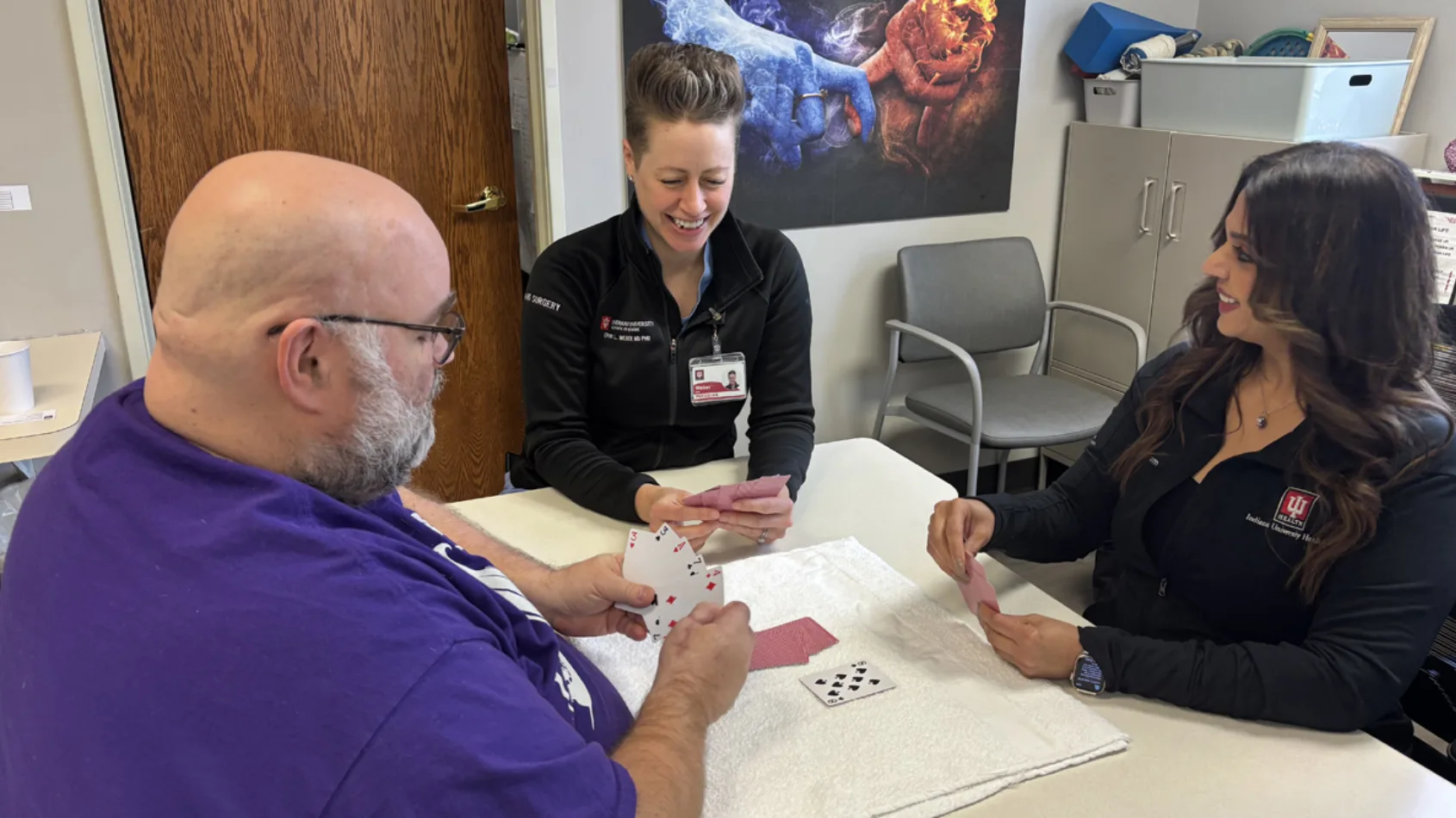
Philip Cave can deal a deck of cards.
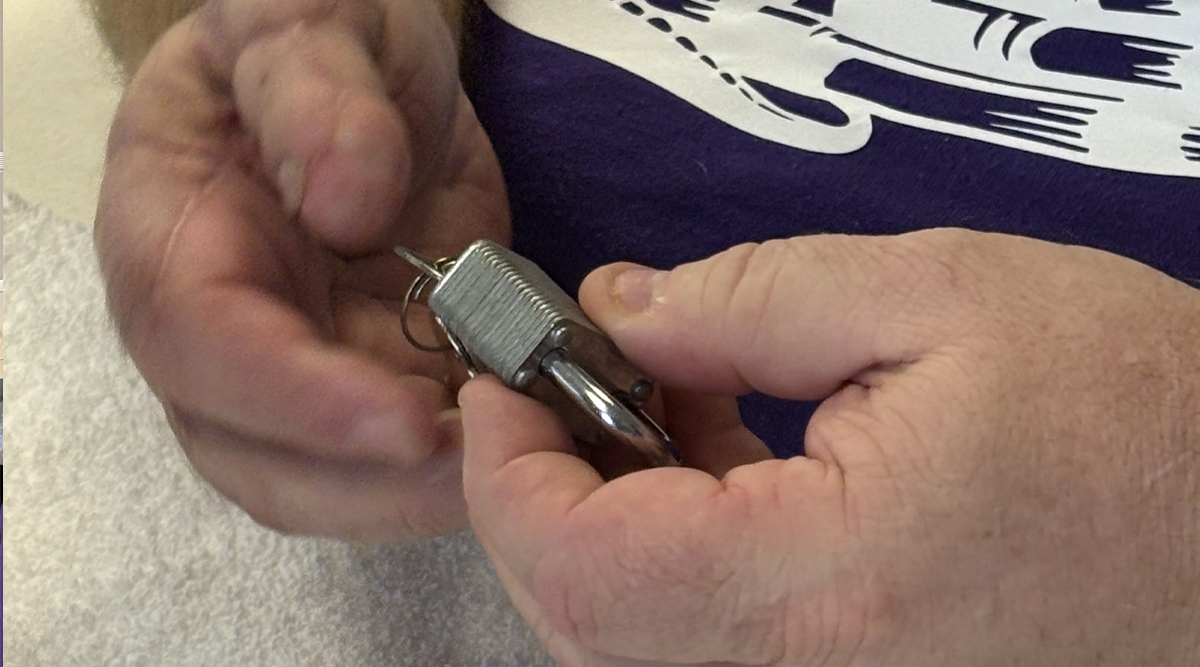
That may not impressive to some, but to Cave, who recently turned 55, that’s a major achievement. He can also turn a key to open a padlock, sign his name with a pen, and pick up a small object like a coin. Cave can also get back to doing something he loves – woodworking.
It’s that favorite hobby that nearly cost Cave long-term functional limitation. On Aug. 25, 2025, Cave, a resident of Trafalgar, Ind. sustained a severe table saw injury to his dominant hand. The injury resulted in open fractures of the right thumb and index finger, with a near amputation of his thumb.
Cave is a man who started his career helping others in group homes and then moving into a career in IT. He’s also helped care for his parents. He and his wife are the parents to two adult children and have two grandchildren.
In no time at all, Cave’s life changed to where others became his caregiver. On the night of the accident, he arrived at IU Health Methodist Hospital where he was in the care of hand and plastic surgeon Dr. Erin Weber.
“I did some fracture stabilization and basically confirmed that his thumb was severely cut in multiple places but was still alive which meant we would save it,” said Dr. Weber. The thumb accounts for approximately 40–50% of overall hand function. It is a necessary part of gripping and precision tasks used in daily living.
More surgeries followed including using part of the bone from near Cave’s elbow o fill in the fractured piece of his thumb. A portion of his left big toe – skin, nail and some bone was used to fill in the missing pieces of his thumb.
“When you transfer the toe, you have to sew all the blood vessels from the toe into the thumb and the vessels are about a millimeter in diameter,” said Dr. Weber, who accomplished the intricate procedure using a microscope, during the hours-long surgery.
“Dr. Weber is a blessing,” said Cave. “When she came out and told my wife that she could save the thumb, it was something I didn’t think I’d ever hear.”
Dr. Weber, who has been a surgeon for six years said this was one of the most complicated procedures she has ever completed; table saw injuries are not uncommon. She has saw two in a single week. “What I like about plastic surgery is you are fixing a problem and recreating the normal structure using another body part – bone or tissue. It’s the idea of building something back in a patient rather than taking something out of the patient,” said Dr. Weber. “I told him I could put it back together but to make it work, it would take a team.”
To accomplish the best results, Cave needed to be healthy enough to go through subsequent surgeries and commit to therapy.
That was the next phase in Cave’s recovery. He began working with occupational therapist Mamta Barmeda, at IU Health Physical Therapy and Rehabilitation.
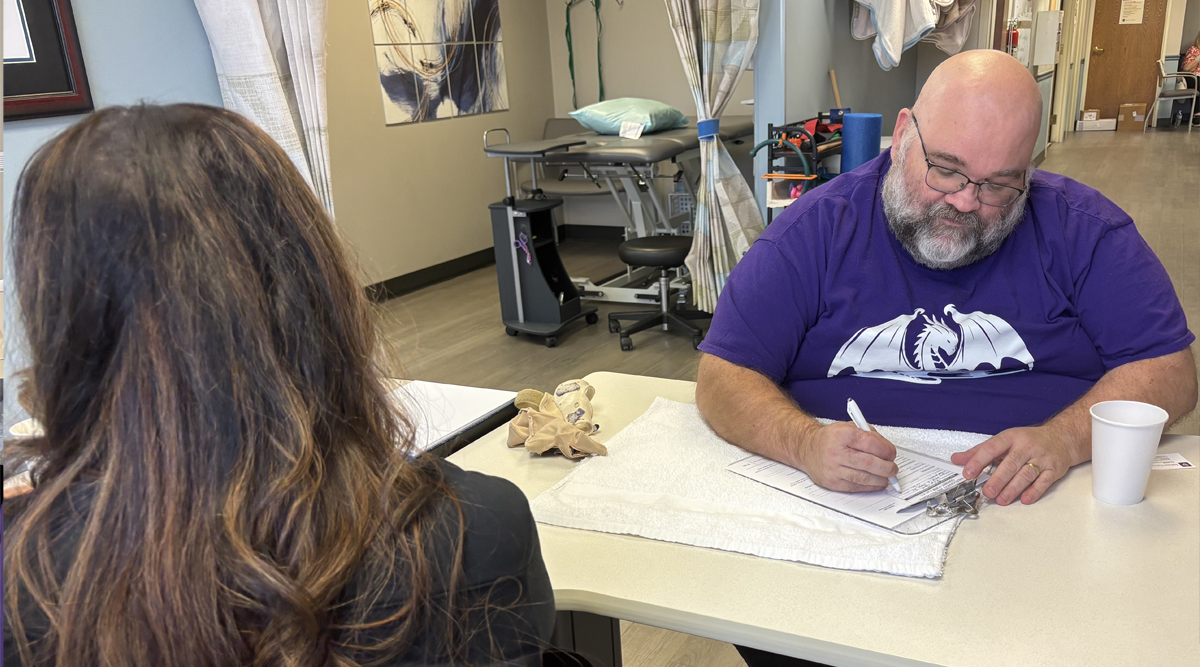
“Philip’s greatest challenge extended beyond surgical healing to learning how to functionally use his reconstructed thumb. Today, he successfully utilizes what he affectionately refers to as his ‘thoe’ (thumb and toe) to perform essential daily activities,” said Barmeda. Cave can groom himself, dress independently, eat using a spoon, grasp objects, pick up a pen, write, and complete household tasks such as laundry.
In on-going therapy sessions, Cave worked on strengthening his grip, managing scars, and regaining function of his right hand.
“When he first came in, he didn’t think he’d be able to pick things up and we took it as a challenge,” said Barmeda, who specializes in hand therapy.
“One of the biggest frustrations through it all has been relying on other people,” said Cave. “I had to learn to free myself and I love to cook but I had to learn to chop vegetables left-handed. It’s nice to be back doing the hard things and the things I love.”